You eat enough fiber. You drink water. Your stool is soft, sometimes almost pasty. And yet every bowel movement is a struggle: you strain, you sit for ten minutes, and you leave the bathroom feeling that something is still stuck. If this sounds familiar, you may be constipated with soft stools, a pattern that confuses many people because they were taught that constipation always means hard, dry stool.
It doesn’t. In gastroenterology, constipation describes how hard it is to empty the bowel, not only how firm the stool is. In this guide, I’ll explain why soft stool and constipation can coexist, what is usually going on inside the pelvis, how doctors confirm it, and which treatments have real evidence behind them.
Can You Be Constipated With Soft Stools?
Yes, you can. Doctors define functional constipation using a set of symptoms, and hard stool is only one of them. The Rome criteria list six features:
- Straining during bowel movements
- Lumpy or hard stools
- A feeling of incomplete emptying
- A sense of blockage in the rectum or anus
- The need for manual help, such as pressing on the perineum or using a finger
- Fewer than three bowel movements per week
You qualify when at least two of these are present on a regular basis over several months. Notice what this means. A person with soft stool who strains, feels blocked, and never feels finished already meets the definition.
So the label “constipated” describes the effort and the sense of incomplete emptying. It does not depend on how the stool looks in the toilet bowl. That distinction is the key to understanding everything that follows.
Why You Can Be Constipated With Soft Stools: A Transit Problem or an Exit Problem
Two separate things have to work for a healthy bowel movement. First, the colon must move stool along toward the rectum. Second, the rectum and the pelvic floor must work together to push stool out.
Doctors call the first step “transit” and the second “evacuation.” Constipation can arise from either one.
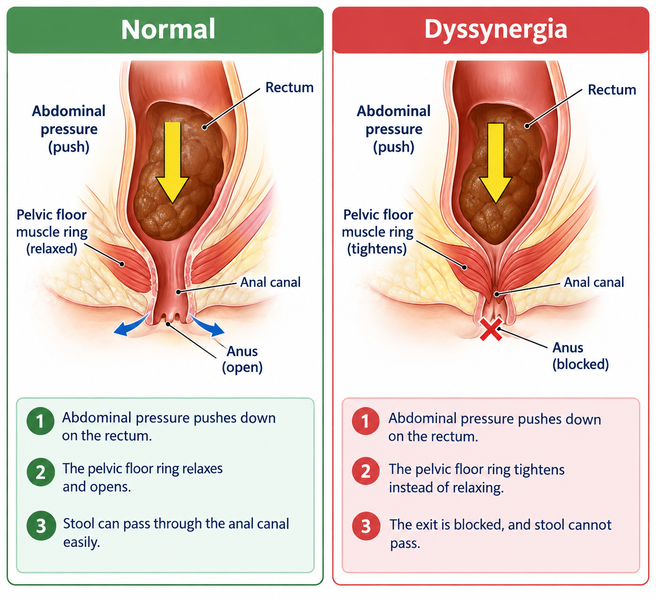
- Slow transit: the colon moves stool too slowly. The stool spends extra time in the bowel, loses water, and becomes hard. This is the classic picture.
- Outlet or evacuation problems: the colon works fine, and the stool may be soft, but the body cannot coordinate the final push. This is the picture behind constipation with soft stools.
Think of a tube of toothpaste. Soft paste flows easily, but if you squeeze the tube while the nozzle is half closed, very little comes out. Stool works the same way. Softening it does nothing if the exit does not open.
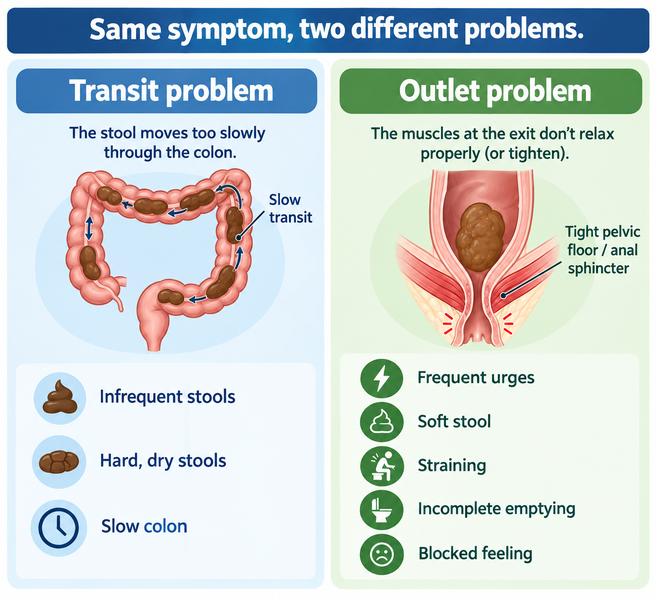
In a normal bowel movement, the rectum senses stool and sends an urge signal. You bear down slightly, the abdominal muscles create pressure, and two muscles around the anus, the puborectalis and the external anal sphincter, relax. The bend between the rectum and anus straightens, and stool passes.
In an outlet problem, this choreography breaks down.
Dyssynergic Defecation: A Leading Cause of Constipation With Soft Stools
The most common outlet problem is dyssynergic defecation, also called pelvic floor dyssynergia or anismus. The name means “poor coordination.” The abdominal muscles push, but the pelvic floor muscles tighten instead of relaxing. Some people also cannot generate enough push to begin with. The result is a fight against your own muscles.
How common is it? Estimates depend on the population studied. The Cleveland Clinic reports that dyssynergic defecation accounts for roughly 15% to 25% of chronic constipation cases, while specialist centers that see the hardest cases report higher figures. Experts agree that it is under-recognized. Patients often go five to ten years with symptoms before anyone names the problem.
Where does it come from? Several patterns appear again and again:
- Childhood habits. About one in three affected people develop the problem early in life, often after learning to hold stool back.
- A triggering event. Another third link it to childbirth, a back or pelvic injury, or surgery.
- Learned straining. Years of pushing against hard stool can teach the pelvic floor to tighten reflexively, and the habit continues even after the stool softens.
- Unknown causes. The remaining cases have no obvious trigger.
Because the muscles can be retrained, this diagnosis is actually good news. It gives you something specific to treat.
Other Causes of Constipation With Soft Stools
Dyssynergia is common, but it is not the only explanation. Your doctor will think about several others.
Rectal hyposensitivity
In roughly half of people with dyssynergic defecation, the rectum senses stool poorly. You do not feel a strong urge until the rectum is very full, so stool sits and you struggle to sense when you are done.
Structural problems
A rectocele, where the rectal wall bulges toward the vagina, can trap stool. It is more common after childbirth and with age. Hemorrhoids, anal fissures, and rectal prolapse can also interfere with emptying.
Slow transit that overlaps with an exit problem
Research has found that delayed colon transit is common in people with disordered defecation. Many patients have both issues at once, which explains why fiber alone rarely fixes the situation.
Laxatives and other medications
If you already take a stool softener or an osmotic laxative, your stool may be soft because of the medicine, not because your bowel works well. The underlying problem stays hidden. Opioids, anticholinergic drugs, and some calcium-channel blockers slow the gut and can worsen straining. Underactive thyroid, diabetes, and neurological conditions can contribute as well.
Irritable bowel syndrome with constipation
IBS-C combines abdominal pain with constipation and often includes a sense of incomplete emptying. If pain and bloating dominate your symptoms, our guide on irritable bowel syndrome and probiotics explains what the evidence says about gut bacteria support.
Overflow around a blockage
Occasionally, hard stool becomes impacted in the rectum, and looser stool leaks around it. This looks like diarrhea but is actually severe constipation. It is most common in older adults and needs medical attention.
Signs Your Constipation With Soft Stools Is a Muscle Coordination Problem
Symptoms alone cannot prove the diagnosis, but certain patterns raise suspicion. Consider whether you notice any of these:
- You strain hard even though the stool is soft or pasty
- Bowel movements take 10 to 20 minutes or more
- You feel blocked, as if something is holding stool back
- You never feel finished, or you need several attempts
- You change positions, lean to one side, or press on your abdomen or perineum to help
- You use a finger to assist, or press on the vaginal wall (splinting)
- You have little warning urge, or a weak one
- Extra fiber or another laxative leaves you more bloated but no more empty
- Stool leaks out later in the day after you thought you were finished
Several of these signs together are a strong reason to ask your doctor about a defecation disorder. Bear in mind that stress can make the picture worse, because tension in the pelvic floor rises with anxiety. Our article on how stress affects digestion covers that gut-brain link in more detail.
How Doctors Diagnose Constipation With Soft Stools
Diagnosis starts with a careful history. Doctors often ask you to keep a bowel diary for one or two weeks, noting stool form using the Bristol Stool Scale, straining, time spent, and any manual help.
Next comes a physical exam that includes a digital rectal exam. A skilled examiner can feel whether the pelvic floor relaxes or squeezes when you bear down, and can identify a rectocele, impacted stool, or an anal problem. Blood tests may check thyroid function, calcium, and blood counts. A colonoscopy or sigmoidoscopy is used when there are alarm features or when age and family history call for screening.
If a defecation disorder is suspected, specialists use tests that look at function:
- Anorectal manometry: a small sensor measures pressure in the anal canal and rectum while you squeeze and push.
- Balloon expulsion test: you try to expel a small water-filled balloon. Failing this test suggests an evacuation problem.
- Defecography: an X-ray or MRI records how the rectum and pelvic floor behave while you pass a stool-like paste.
- Colonic transit study: you swallow small markers, and an X-ray days later shows how fast they move through the colon.
According to the Cleveland Clinic, doctors generally confirm dyssynergic defecation when two or more of these tests are abnormal. That approach reduces the risk of a false label based on one odd result.
Treating Constipation With Soft Stools: What Actually Works
Treatment depends on the cause. When the problem is a coordination disorder, the most effective option is not a stronger laxative. It is retraining the muscles.
Biofeedback therapy
Biofeedback is the best-studied treatment for dyssynergic defecation. A trained therapist uses sensors and a screen to show you what your abdominal and pelvic floor muscles are doing. You practice pushing while relaxing the pelvic floor until the coordinated pattern feels natural. Some programs also train rectal sensation with a small balloon.
The evidence is strong. In a randomized trial from the group led by Satish Rao, biofeedback produced sustained improvement in bowel symptoms and anorectal function at one year, while standard treatment was largely ineffective. Professional guidelines from neurogastroenterology societies recommend it for this condition. Newer research also suggests that home-based programs can work nearly as well as clinic sessions, which makes treatment easier to access.
Toilet posture and technique
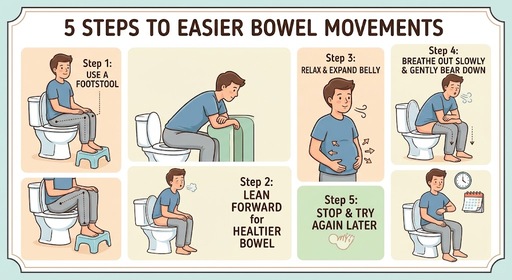
Small changes in how you sit and push can lower the effort. Try these steps:
- Put a small footstool under your feet so your knees sit above your hips. This posture relaxes the puborectalis and widens the anorectal angle.
- Lean forward and rest your forearms on your thighs.
- Let your belly relax and expand as you breathe in, rather than holding your breath.
- As you breathe out slowly, gently bear down. Do not force or hold a long strain.
- Stop after a few minutes if nothing happens, and try again later instead of pushing harder.
Avoid reading or scrolling on your phone while you sit, since long toilet sessions encourage more straining.
Habits that support a healthy reflex
- Respond to the urge. Ignoring it teaches the rectum to stop sending strong signals.
- Use the meal reflex. Eating triggers colon movement, so many people find the best window is 15 to 30 minutes after breakfast.
- Reconsider adding more fiber or laxatives. When stool is already soft and still hard to pass, piling on more bulk may add bloating without solving anything. Do not stop your current medicines without speaking to your doctor first.
- Be realistic about home remedies. Herbs and foods may loosen stool, but they cannot retrain a tight pelvic floor. Our reviews of herbs for constipation, garlic for constipation, and mixed nuts and bowel movements can help you judge which options are worth trying alongside proper treatment.
Medical and surgical options
Your doctor may review medicines that slow the gut, treat an underlying thyroid or metabolic problem, and use laxatives when colonic slow transit is part of the picture. Structural problems such as a large rectocele or rectal prolapse may need a colorectal or pelvic surgeon. These options come after the basics, not before.
When to See a Doctor About Constipation With Soft Stools
Many people live with this problem for years before asking for help. Embarrassment is common, but these symptoms are routine for a gastroenterologist. Make an appointment if constipation with soft stools lasts more than a few weeks, keeps returning, or affects your daily life.
See a doctor promptly if you notice any of these alarm signs:
- Blood in the stool or on the toilet paper
- Unintended weight loss
- Iron deficiency or unexplained anemia
- New constipation that begins after age 50
- A family history of colorectal cancer or inflammatory bowel disease
- Persistently thin, pencil-like stools
- Severe or worsening abdominal pain, vomiting, or fever
- Leakage of stool or liquid stool that seems to come around a blockage
Frequently Asked Questions About Constipation With Soft Stools
Can soft stool still mean I’m constipated?
Yes. If you strain, feel blocked, or never feel fully empty, you can be constipated even when the stool is soft.
Why do I strain with soft stool?
Often the pelvic floor muscles fail to relax while you push, a condition called dyssynergic defecation. Other possible causes include a rectocele, poor rectal sensation, or medicines that slow the gut.
Will more fiber fix constipation with soft stools?
Not usually. Fiber helps when stool is hard or transit is slow. If the problem is muscle coordination, fiber can add bulk without making the exit any easier.
Is biofeedback painful?
It is generally not painful. Sensors are placed on or just inside the anus, and you practice muscle control while watching a screen. Some people find it awkward at first, but most adapt quickly.
Can constipation with soft stools go away on its own?
Occasional episodes often do. A long-standing pattern of straining with incomplete emptying usually needs a proper evaluation and targeted treatment.
Final Thoughts on Being Constipated With Soft Stools
Soft stool does not rule out constipation. When you strain, feel blocked, or never feel done, the cause is often a coordination problem at the exit rather than a problem with the stool itself. That is why stronger laxatives and endless fiber so often disappoint.
The encouraging part is that the pattern is recognizable and treatable. A careful history, a rectal exam, and a few focused tests can identify the cause, and biofeedback with better toilet technique can retrain the muscles involved. If this article describes you, bring it up at your next appointment.
Medical disclaimer: This article offers general education and does not replace personal medical advice, diagnosis, or treatment. Speak to a qualified healthcare professional about your symptoms, especially if you notice any of the warning signs listed above.
Sources:
- Cleveland Clinic, Anismus (Dyssynergic Defecation): Causes, Symptoms — https://my.clevelandclinic.org/health/diseases/23138-anismus-dyssynergic-defecation
- Rao SSC et al., Long-term efficacy of biofeedback therapy for dyssynergic defecation: randomized controlled trial (PubMed) — https://pubmed.ncbi.nlm.nih.gov/20179692/
- IFFGD, Dyssynergic Defecation: About a Common Cause of Chronic Constipation — https://iffgd.org/gi-disorders/lower-gi-disorders/dyssynergic-defecation/