If you’ve had years of stomach attacks that come out of nowhere, last a day or two, and then vanish completely — with every scan, scope, and blood test coming back normal — you’ve probably been told it’s “just IBS,” stress, or “nothing showing up.” For a small subset of adults, the real explanation is something most gastroenterologists were trained to think of as a childhood problem: abdominal migraine.
Abdominal migraine in adults is one of the most under-recognized causes of recurrent, unexplained belly pain in medicine today. It isn’t rare because it doesn’t happen — it’s rare because almost no one is looking for it. This guide walks through what abdominal migraine actually is, how it differs from IBS and other functional gut disorders, and what the current evidence says about treating it.

What Is Abdominal Migraine in Adults?
Abdominal migraine is a recognized migraine variant — not a separate stomach disease — in which the pain of a migraine attack is felt mainly in the abdomen instead of the head. It’s formally classified as a disorder of gut-brain interaction and also appears in the International Classification of Headache Disorders, which tells you something important: this condition sits at the intersection of neurology and gastroenterology, and it can fall through the cracks of both specialties.
The textbook picture is a child with recurring stomachaches around the belly button, each episode lasting hours, followed by complete normalcy in between. That picture is accurate — abdominal migraine is far better documented in children, with a prevalence estimated between roughly 0.2% and 4% of school-age kids. What’s less well known, even among physicians, is that a meaningful number of these children don’t simply “grow out of it.” Some carry the same pattern into adulthood, and a smaller group develops it for the first time as adults, typically with no childhood history at all.
A 2025 systematic review pooling data from more than five decades of published case reports found only 33 documented adult cases across 63 studies, compared with 629 pediatric cases — not because adult abdominal migraine is a thousand times rarer, but because it’s a thousand times less likely to be recognized and written up. Among the cases with detailed symptom data, nausea, vomiting, and headache were all commonly reported alongside the abdominal pain, along with photophobia, pallor, and loss of appetite. That overlapping symptom pattern is exactly why it gets mistaken for something else.
How Common Is Abdominal Migraine in Adults, Really?
The honest answer is that no one knows the true prevalence. What the literature does show is a pattern of delayed recognition: in that same 2025 review, the median age at onset was 31 years old in adults, with an average diagnostic delay of about four years after symptoms began. Four years of stomach attacks, scans, and often multiple specialists before someone lands on the right diagnosis.
Most published adult cases share a similar profile: a woman in her twenties to forties, with a personal or family history of migraine headaches, who has already had a full gastrointestinal workup — bloodwork, imaging, sometimes endoscopy or colonoscopy — that came back essentially normal. If that sounds like your own story, or a patient’s, abdominal migraine deserves a seat at the table of possible explanations.
Abdominal Migraine Symptoms in Adults
The core feature of abdominal migraine in adults is episodic, not constant, pain. Between attacks, digestion and bowel habits are normal. That’s one of the biggest clues that separates it from most other chronic gut conditions.
The pain itself
- Moderate to severe abdominal pain, usually centered around or near the belly button, though it can be more diffuse
- Attacks that last anywhere from about 2 to 72 hours
- Complete symptom freedom between episodes — this “clean slate” pattern is a hallmark
- Pain intense enough to interfere with work, school, or normal activity during an attack
Associated symptoms
Because this is a migraine process rather than a purely digestive one, attacks often come bundled with symptoms you wouldn’t expect from a stomach bug or IBS flare:
- Nausea and vomiting
- Loss of appetite
- Pale skin (pallor)
- Sensitivity to light or sound
- Headache — though notably, headache doesn’t have to be present at all for the diagnosis to apply
- A personal or family history of migraine headaches
The absence of headache trips a lot of patients and doctors up. It’s tempting to rule out “migraine” as a cause of stomach pain simply because there’s no head pain involved, but abdominal migraine is specifically defined as a migraine equivalent that can occur with little to no head involvement.

What Causes Abdominal Migraine in Adults?
Like migraine headaches themselves, abdominal migraine doesn’t have one single identified cause. The leading explanation involves the same gut-brain axis that’s implicated in many functional GI disorders, but with a migraine-specific twist: episodic changes in blood flow and nerve signaling that, in classic migraine, affect the blood vessels and nerves of the brain, may instead — or additionally — affect the nerves and blood supply of the gut.
A few threads that show up repeatedly in the case literature:
- Family history of migraine. A strong majority of adult cases report migraine headaches somewhere in the family tree, supporting a shared underlying predisposition rather than two unrelated conditions.
- Personal history of migraine or its childhood precursors. Conditions considered “childhood periodic syndromes” — cyclic vomiting syndrome, benign paroxysmal vertigo of childhood, even infantile colic in some proposed models — are thought to sit on the same spectrum as migraine and abdominal migraine.
- Common migraine triggers. Stress, poor sleep, skipped meals, certain foods, hormonal shifts, and sensory overload have all been reported as triggers for abdominal attacks, the same way they trigger head migraines in other people.
- Serotonin and vascular signaling. Serotonin plays a role in both classic migraine and in gut motility and sensation, which is one proposed biological bridge between the two.
None of this is fully settled science. Reviewers studying adult cases have been candid that the mechanism remains poorly understood and that most of what’s known comes from case reports rather than large controlled studies — which is also exactly why it’s so easy for this diagnosis to be overlooked.
Diagnosing Abdominal Migraine in Adults
There’s no blood test, scan, or scope finding that confirms abdominal migraine. It’s a clinical diagnosis, made by pattern recognition and by ruling out other explanations — which is part of why the diagnostic delay tends to run into years.
A reasonable diagnostic path looks like this:
- A thorough history focused on pattern, not just symptoms. How long do attacks last? Is there truly a symptom-free period in between? Any family history of migraines?
- Exclusion of structural and metabolic causes. This typically means bloodwork, abdominal imaging, and sometimes endoscopy to rule out conditions like peptic ulcer disease, gallbladder disease, inflammatory bowel disease, celiac disease, and pancreatitis.
- Application of formal diagnostic criteria. Both the Rome IV criteria (used for gut-brain disorders generally) and the International Classification of Headache Disorders include specific criteria for abdominal migraine, requiring a set number of attacks with the features described above and no other identifiable cause.
- Consideration of related periodic syndromes. Cyclic vomiting syndrome is the condition most often confused with abdominal migraine — the biggest distinguishing feature is that cyclic vomiting syndrome involves severe, frequent vomiting as the dominant symptom (sometimes several times an hour), while abdominal migraine is primarily a pain disorder with vomiting as a secondary feature.
If you’ve been told your workup is “clean” but the attacks keep recurring in a predictable, episodic pattern, it’s worth explicitly asking your gastroenterologist or a headache specialist whether abdominal migraine fits.
Abdominal Migraine vs. IBS and Other Conditions
This is where most misdiagnoses happen, so it’s worth spelling out the differences directly.
Abdominal migraine vs. IBS. IBS pain is typically linked to bowel movements — it often improves after passing stool and is accompanied by a change in stool frequency or consistency. Abdominal migraine pain is not tied to bowel habits at all, and bowel function is usually completely normal between attacks. We’ve covered how FODMAP-related gas and bloating patterns show up in IBS in our guide to burping and excessive gas, which is a useful comparison if you’re trying to figure out whether your symptoms fit the IBS mold or not.
Abdominal migraine vs. cyclic vomiting syndrome. As mentioned above, the two overlap heavily and some researchers consider them part of the same spectrum. Vomiting frequency and severity is the key differentiator.
Abdominal migraine vs. functional dyspepsia. Functional dyspepsia tends to center on the upper abdomen with a relationship to eating — early fullness, post-meal discomfort. Abdominal migraine attacks are more likely to be independent of meals and centered around the navel.
Abdominal migraine vs. gastroparesis, gallbladder disease, or other structural problems. These are typically excluded during the initial workup through imaging and, when indicated, endoscopy.
Treating Abdominal Migraine in Adults
Because adult abdominal migraine is so under-studied, there’s no single approved, standardized treatment protocol. What exists instead is a body of case reports and small reviews borrowing directly from migraine headache treatment — with reasonable, if not definitive, success.
For an acute attack
- NSAIDs are a reasonable first step for milder attacks
- Triptans (the same medications used for migraine headaches) have shown strong response rates in case reports for aborting attacks already in progress
- Anti-nausea medications for the vomiting component
- Rest in a quiet, dark, low-stimulation environment — the same advice given for head migraines applies here too
For prevention
When attacks are frequent enough to disrupt daily life, prophylactic (preventive) therapy is usually considered, generally drawn from standard migraine-prevention medications:
- Topiramate, an anticonvulsant used widely in migraine prevention
- Beta-blockers
- Tricyclic antidepressants, particularly amitriptyline
- Calcium channel blockers
- Antihistamines such as cyproheptadine, which has strong case-report support in pediatric abdominal migraine and is sometimes extended to adults
Non-drug approaches
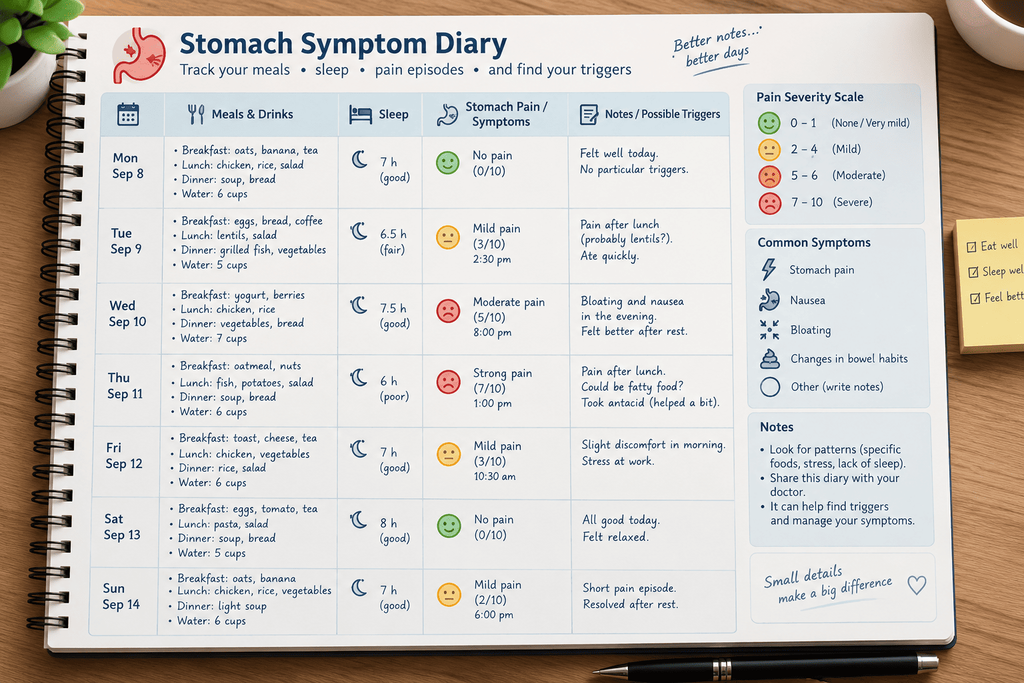
- Trigger identification. Keeping a symptom diary that tracks meals, sleep, stress, and hormonal cycles alongside attack timing can reveal personal triggers the same way it does for classic migraine.
- Regular sleep and meal schedules. Migraine of all types is sensitive to irregular routines, and abdominal migraine appears to be no exception.
- Stress management. The gut-brain axis runs in both directions — chronic stress can lower the threshold for an attack, and calming techniques that support vagal tone may help reduce overall gut sensitivity. We go into more depth on how the vagus nerve influences digestion in our article on water and bloating, which touches on the same gut-brain wiring at play here.
- Cognitive behavioral therapy. Some case reports describe benefit from CBT alongside medication, consistent with its established role in other gut-brain disorders like IBS.
It’s worth being upfront that evidence quality here is limited — most of what’s published comes from individual case reports rather than randomized trials, so response rates reported in the literature likely overstate real-world success to some degree. Still, for a condition with essentially no other treatment framework, borrowing carefully from migraine management under a physician’s guidance is currently the most reasonable path.
When to See a Doctor
Abdominal migraine is a diagnosis of exclusion, which means the first priority is always ruling out anything more dangerous. Seek medical evaluation — and don’t assume it’s abdominal migraine on your own — if you experience:
- Recurrent abdominal pain severe enough to disrupt daily life
- Pain accompanied by fever, blood in stool or vomit, unintentional weight loss, or jaundice
- A first episode after age 50 (new-onset abdominal migraine that late is unusual and warrants a thorough workup for other causes)
- Progressively worsening episodes rather than a stable pattern
- Any red-flag symptom your doctor hasn’t already specifically cleared
A gastroenterologist is typically the right starting point, and a referral to a headache specialist or neurologist can be valuable once structural gut disease has been excluded, since abdominal migraine ultimately sits in both fields. Patient advocacy groups like the American Migraine Foundation also maintain plain-language resources if you want a starting point to bring to that conversation.
Frequently Asked Questions
Can adults develop abdominal migraine without ever having had headaches?
Yes. Headache is not required for the diagnosis. Many documented adult cases involve abdominal attacks with little to no accompanying head pain, which is part of why the condition is so easy to miss.
Is abdominal migraine dangerous?
Abdominal migraine itself isn’t considered dangerous or life-threatening, but because its symptoms overlap with more serious conditions, it should only be diagnosed after those conditions have been ruled out.
Does abdominal migraine show up on a CT scan or colonoscopy?
No. By definition, structural imaging and endoscopy are normal in abdominal migraine. Those tests are used to exclude other causes, not to confirm this one.
How is abdominal migraine different from a stomach bug?
A stomach virus is typically a one-off illness with a clear infectious trigger and a defined recovery. Abdominal migraine is a chronic, recurring pattern with complete symptom-free intervals between attacks, often stretching over months or years.
Can diet changes help abdominal migraine?
Some patients find that identifying and avoiding personal dietary triggers (in the way migraine sufferers track food triggers) reduces attack frequency, and one case report suggested benefit from a low-amine, high-fiber diet. This isn’t standardized, so it’s best approached as a personal trial-and-error process rather than a universal prescription.
This article is intended for general educational purposes and isn’t a substitute for personalized medical advice. If you’re experiencing recurrent, unexplained abdominal pain, talk to a gastroenterologist or your primary care provider about proper evaluation.