That knot in your stomach before a big presentation. The urgent bathroom trip during a stressful commute. The heartburn that only shows up during finals week or budget season. None of this is a coincidence, and it’s not “all in your head.” How stress affects digestion is one of the most well-documented mind-body connections in medicine, and understanding it is often the missing piece for people who’ve tried every elimination diet and supplement without relief.
Your gut and your brain are in constant, two-way conversation. When that conversation turns anxious, your digestive system listens — and reacts. This isn’t a minor side effect, either: functional gastrointestinal disorders linked to the gut-brain axis, like irritable bowel syndrome and functional dyspepsia, are among the most common reasons people see a gastroenterologist, and stress is consistently one of the strongest triggers researchers can identify for flares.
Below, we’ll walk through exactly what happens in your body during stress, which symptoms it tends to produce, and what actually helps calm things down — beyond just “try to relax,” which is easier said than done when your stomach is the one sounding the alarm.
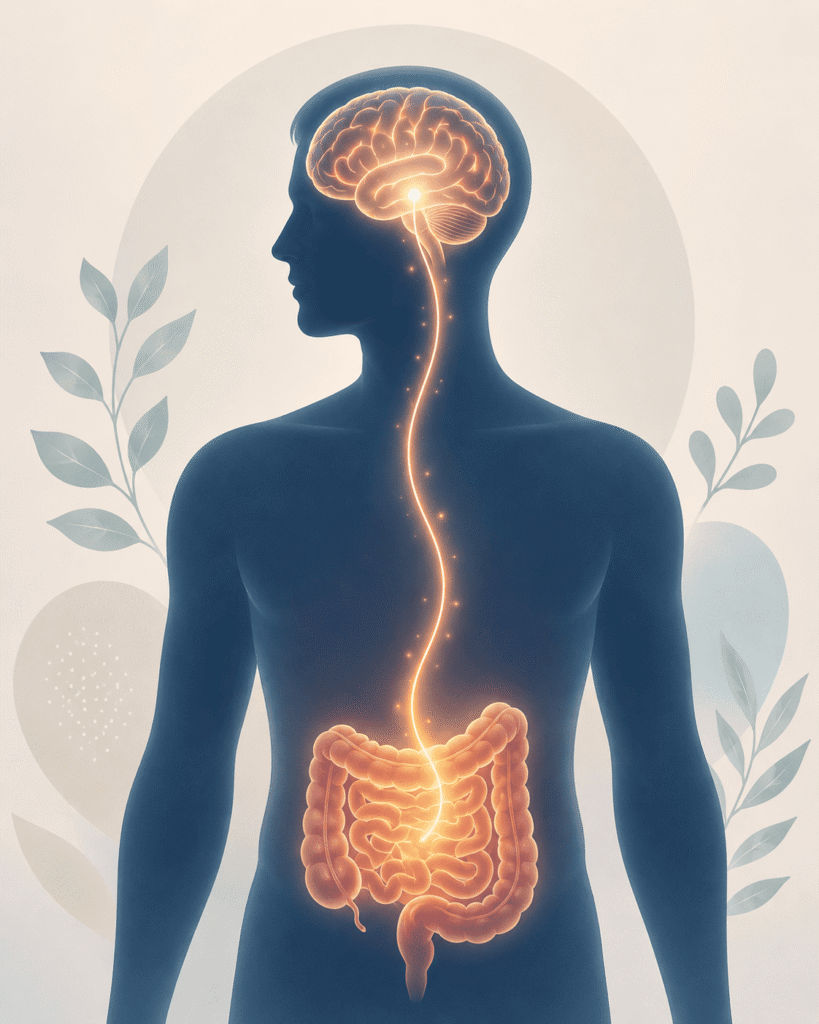
What Is the Gut-Brain Connection? How Stress Affects Digestion Explained
Your gastrointestinal tract has its own nervous system, called the enteric nervous system, made up of more than 500 million neurons — more than you’ll find anywhere else in your body outside your brain. Because it can sense conditions inside your gut and generate a response somewhat independently, researchers sometimes call it a “second brain.”
This second brain doesn’t work alone. It’s linked to your central nervous system through the vagus nerve, a long cranial nerve that carries sensory signals from your gut up to your brain and motor signals back down. Roughly 80% of the fibers in the vagus nerve actually run from gut to brain rather than the other way around, which is part of why physical sensations in your digestive tract can shape your mood just as much as your mood shapes your digestion.
Your gut microbiome — the trillions of bacteria living in your intestines — also plays a role in this conversation. These microbes help produce many of the same neurotransmitters your brain uses to communicate, including a large share of your body’s serotonin. Chronic stress can shift the balance of these bacteria, and an altered microbiome can, in turn, send signals back up the vagus nerve that influence mood and gut sensitivity. Together, this network is what clinicians refer to as the gut-brain axis, and it’s the reason emotional states can so directly shape gut function, and vice versa.
Under normal conditions, this back-and-forth keeps digestion running smoothly. It’s how your gut knows to release digestive enzymes when food arrives, and how your brain gets an early warning if something’s wrong. But when your nervous system perceives a threat — whether that’s a real emergency or a looming deadline — the same wiring reroutes resources away from digestion and toward survival, which is where symptoms start.
The Science: How Stress Affects Digestion Step by Step
Stress affects digestion through a well-mapped chain of events, starting in the brain and ending in your gut.
When your brain perceives stress, it activates the hypothalamic-pituitary-adrenal (HPA) axis, triggering the release of cortisol and adrenaline. This is your body’s fight-or-flight response, and it’s designed for short bursts of danger — not for a stressful inbox that never empties. Here’s what it does to digestion along the way:
- Blood flow is redirected. Adrenaline diverts blood away from your digestive organs toward your muscles, since your body assumes you’ll need to run or fight rather than digest a meal.
- Motility becomes irregular. Cortisol and stress hormones interfere with the muscle contractions that move food through your stomach and intestines. Some people experience slowed motility, leading to bloating, nausea, and constipation. Others experience the opposite, with the large intestine speeding up and triggering urgency or diarrhea.
- Stomach acid production shifts. Chronic stress is linked to increased gastric acid secretion combined with reduced motility, a combination that raises the likelihood of reflux and that heavy, unsettled feeling after eating.
- The gut lining becomes more permeable. Research on the stress response shows that prolonged activation of the HPA axis can loosen the tight junctions between intestinal cells, a change generally described as increased intestinal permeability. This allows more irritants to cross the gut lining, which can contribute to inflammation and heightened sensitivity to normal digestive sensations.
- The gut becomes more sensitive to pain. Chronic stress can lower your threshold for what counts as an uncomfortable sensation, so ordinary digestion — a bit of gas, a normal stretch of the intestinal wall — starts to register as pain.
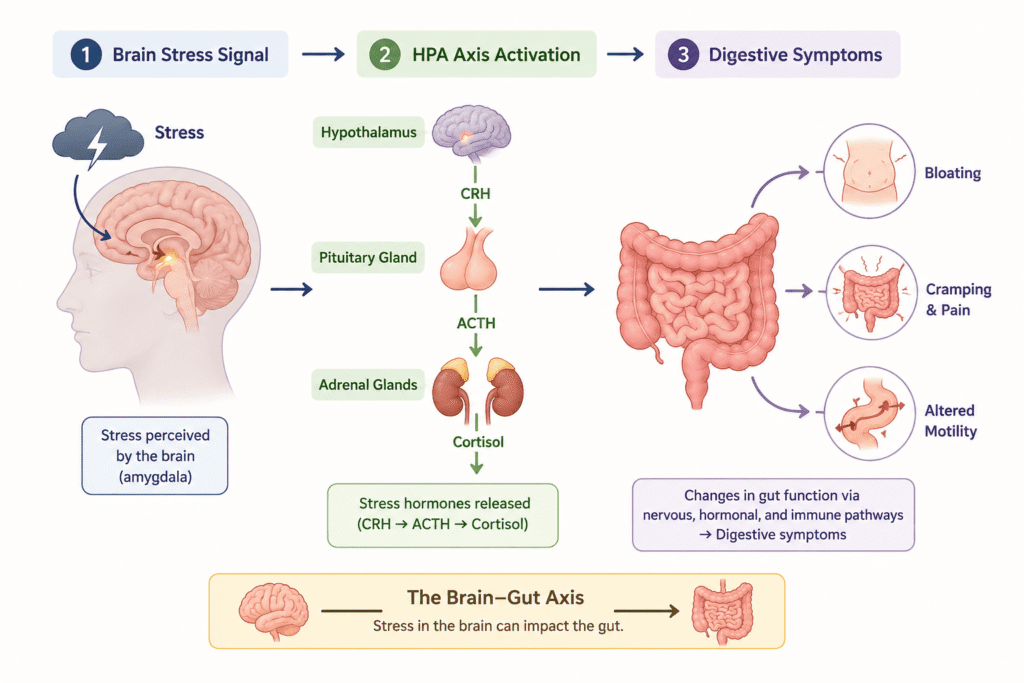
Common Digestive Symptoms Stress Can Trigger
Not everyone experiences stress in their gut the same way, but a few patterns show up consistently in people whose digestion reacts to pressure:
- Stomach pain or cramping, often described as a knot or tightness, driven by irregular muscle contractions in the intestinal wall
- Bloating and gas, particularly after meals eaten quickly or while distracted, since swallowed air and slowed motility both increase
- Nausea or loss of appetite during acute stress, as blood flow shifts away from digestion
- Diarrhea, constipation, or alternating between the two, depending on whether your particular stress response speeds up or slows down colon motility
- Heartburn or a burning sensation in the chest or throat, from a combination of extra stomach acid and a more reactive esophagus
- A dry mouth or difficulty swallowing during anxious moments, a direct effect of the fight-or-flight response reducing saliva production
- A vague, persistent “unsettled stomach” that doesn’t map to anything you ate, often the clearest sign that the trigger is nervous system activity rather than a specific food
If several of these sound familiar, it’s worth tracking whether they cluster around stressful periods — a pattern that’s a strong clue the gut-brain connection is involved rather than a single food trigger. A simple symptom-and-stress diary for two or three weeks is often more revealing than another round of food elimination.
How Stress Affects Digestion in People With IBS
Irritable bowel syndrome is where the gut-brain connection is most visible, and most disruptive. People with IBS tend to have a gut that’s more reactive to stress signals than average, a phenomenon researchers call visceral hypersensitivity. In practice, that means a stress response that might cause mild discomfort in someone else can trigger a full flare — cramping, urgency, and bloating — in someone with IBS.
This is also why IBS symptoms so often track a person’s stress calendar rather than their diet alone. A flare during a hectic work week, followed by calm once things settle down, is a classic sign that the gut-brain axis is driving the symptom pattern. If bloating is your dominant symptom and you’re trying to untangle how much is fluid-related versus stress-related, our guide to water bloating and its triggers walks through how to tell the difference.
The good news is that because IBS is so closely tied to the gut-brain axis, therapies that target the nervous system side of the equation — not just diet — tend to produce meaningful relief, which we’ll cover below.
Stress, Heartburn, and Acid Reflux: The Digestive Link
Stress doesn’t directly cause gastroesophageal reflux disease, but it reliably makes reflux symptoms worse and more noticeable. Two mechanisms are at play: stress can increase how much stomach acid you produce, and it can also heighten how sensitive your esophagus is to that acid, so the same amount of reflux feels more intense during a stressful stretch.
Stress-related eating habits compound the problem — eating quickly, skipping meals and then overeating later, or reaching for caffeine and carbonated drinks under pressure all increase how much air and acid end up where they shouldn’t. If burping and gas are part of your pattern alongside reflux, our guide to burping and excess gas covers the eating habits most likely to be contributing.
Practical Ways to Calm How Stress Affects Your Digestion
You can’t eliminate stress from life, but you can influence how much of it reaches your gut. A few approaches have consistent support:
- Diaphragmatic (belly) breathing. Slow, deep breathing activates your vagus nerve directly, shifting your nervous system out of fight-or-flight and into “rest and digest” mode. Even five minutes before or after a meal can measurably calm digestion.
- Gut-directed relaxation and cognitive behavioral therapy (CBT). These approaches, often used for IBS, train your nervous system to interpret gut sensations more accurately instead of reflexively signaling alarm. They’re increasingly available through GI-specialized therapists and structured programs.
- Eating without distraction. Eating in a rushed, stressed, or screen-distracted state keeps your nervous system in a heightened state during digestion. Sitting down, chewing thoroughly, and slowing the pace of a meal helps your body register that it’s safe to digest.
- Regular movement. Moderate exercise lowers baseline cortisol over time and supports healthy gut motility, which helps counteract stress-related constipation or sluggish digestion.
- Prioritizing sleep. Poor sleep raises cortisol and lowers your tolerance for stress the next day, creating a cycle that shows up directly in digestive symptoms.
- Supporting regularity gently. If stress has left you constipated, gentle, well-tolerated options are often a better starting point than harsh stimulant laxatives. Our breakdown of the best herbs for constipation covers options worth discussing with your doctor, including how to introduce them safely.
- Limiting stress-stacking habits during flares. Caffeine, alcohol, and large late-night meals all place extra demand on a digestive system that’s already under strain from stress hormones. Trimming these back temporarily during a stressful stretch, rather than permanently, is often enough to take the edge off symptoms.
None of these strategies work as an instant fix, but used consistently, they retrain the gut-brain conversation over weeks rather than days. The goal isn’t to eliminate stress entirely — that’s not realistic for most people’s lives — but to give your nervous system enough recovery time between stressors that your gut isn’t in a near-constant state of alarm.

When Stress-Related Digestive Symptoms Need a Doctor
Stress-related digestive symptoms are uncomfortable but usually not dangerous on their own. That said, some signs point to something beyond stress and deserve a medical evaluation rather than more coping strategies:
- Unintentional weight loss
- Blood in your stool or black, tarry stools
- Persistent vomiting
- Difficulty swallowing
- Pain that wakes you from sleep or is severe and doesn’t ease
- Symptoms that started suddenly after age 50
- A family history of colorectal cancer, celiac disease, or inflammatory bowel disease alongside new symptoms
If any of these apply to you, or if stress-management strategies haven’t improved your symptoms after several weeks of consistent effort, it’s worth talking to a doctor to rule out other causes before assuming stress is the sole driver.
FAQ: How Stress Affects Digestion
Can stress alone cause IBS?
Stress doesn’t appear to cause IBS on its own, but it’s one of the strongest known triggers for flares in people who already have it, largely because of visceral hypersensitivity in the gut-brain axis.
How long does it take for stress-related stomach issues to go away?
Acute symptoms often ease within hours to a few days once the stressful event passes. Chronic, ongoing stress can keep symptoms simmering for weeks or months until the underlying stress is addressed.
Does stress-related bloating look different from food-related bloating?
Stress-related bloating tends to build gradually across a stressful day and ease with relaxation, while food-related bloating usually follows a specific meal more predictably. Tracking timing against your calendar, not just your plate, can help you tell them apart.
Can therapy really help physical digestive symptoms?
Yes. Approaches like cognitive behavioral therapy and gut-directed relaxation training have research support specifically for functional GI symptoms, not just mood, because they work through the same nervous system pathways that regulate gut function.
Is it normal to lose your appetite when stressed?
Yes, this is common. Stress hormones can suppress appetite in the short term as part of the fight-or-flight response, though some people experience the opposite and reach for food for comfort.
This article is for general educational purposes and isn’t a substitute for personalized medical advice. If you’re dealing with persistent or severe digestive symptoms, please consult a doctor or gastroenterologist for an evaluation.




Pingback: How to Reverse Fatty Liver: A Gastroenterologist's Guide - GutConsultant
Pingback: Constipated With Soft Stools: Why It Happens and What Helps - GutConsultant