You drank the prep, survived a long night in the bathroom, and the colonoscopy is finally done. Then a new question appears. Why haven’t I gone yet? Or why am I still running to the toilet? Questions about bowel movements after colonoscopy are among the most common calls an endoscopy unit receives. The good news is that most changes are temporary and easy to explain.
In this guide, I’ll walk you through what happens to your bowel during and after the procedure. You’ll learn the usual recovery timeline and the signs that deserve a phone call. I’ll also cover a question most articles skip: what it means when your bowel habits still feel “off” weeks later.
Why Bowel Movements After Colonoscopy Change
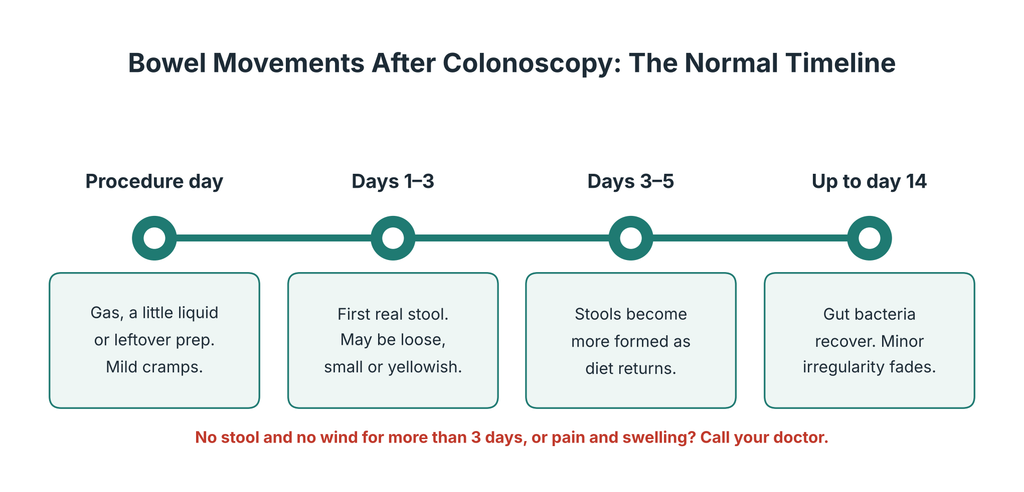
A colonoscopy affects your gut in several ways at once. Each one can shift your normal rhythm for a few days.
The bowel prep empties you completely
Bowel preparation solutions are strong osmotic laxatives. They pull large amounts of water into the colon and flush out almost all stool. Most people also follow a low-fibre diet and then clear liquids before the test. So after the procedure, there is very little left to pass. Your colon needs time to refill before a normal stool can form.
Gas stretches the colon
To see the lining clearly, the endoscopist gently inflates the colon with gas. Many units now use carbon dioxide, which the body absorbs much faster than room air. Trials comparing the two show less pain and bloating after the procedure with carbon dioxide. Even so, some gas remains. It usually leaves as wind or comes out with your first, rather watery, bowel movements.
Sedation slows the gut
The sedative and pain-relief drugs we use during the procedure can briefly slow gut movement. Opioid-type medicines are especially known for this. The effect is short, but it can delay your first bowel movement by a day or so.
Your gut bacteria get a temporary shake-up
This part surprises many patients. In a randomised study published in Gut, bowel cleansing cut the total amount of gut bacteria by about 31-fold. For most volunteers, bacterial levels and community makeup recovered within about two weeks. Interestingly, a split-dose prep (two smaller doses) caused smaller changes than one large dose. That’s one more reason to follow your unit’s split-dose instructions.
Mild dehydration
Prep pulls fluid out of your body as well as your bowel. If you don’t replace it, mild dehydration can make the first stools harder and slower to arrive.
The Normal Timeline for Bowel Movements After Colonoscopy
Everyone’s gut resets at its own pace. Still, most patients follow a predictable pattern.
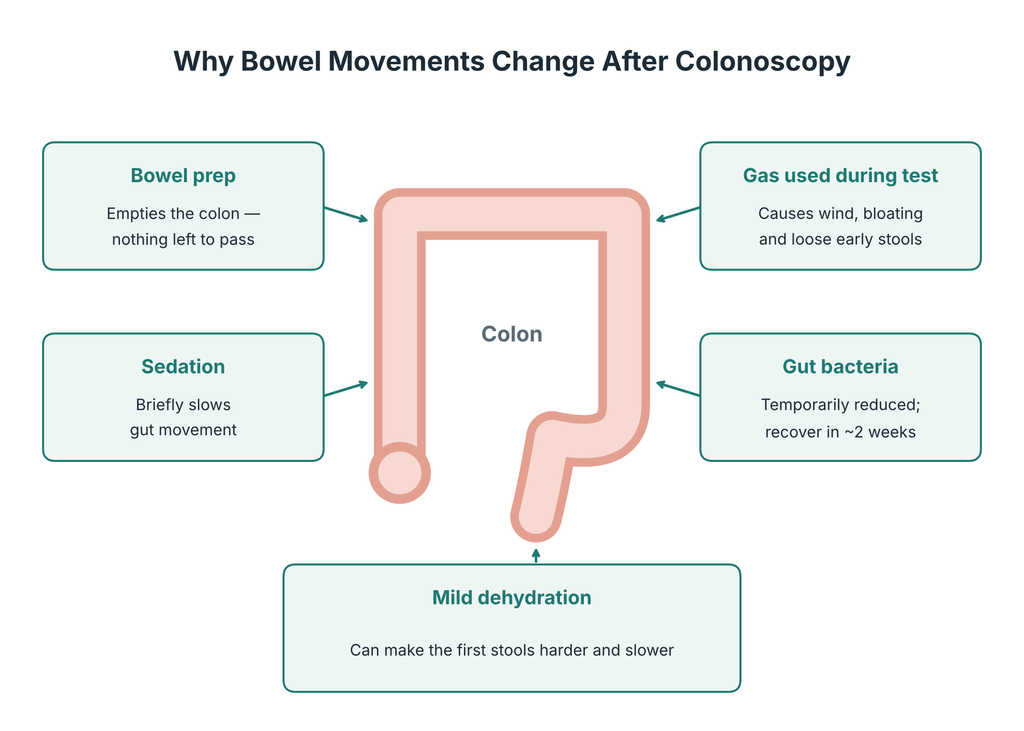
- Procedure day: You may pass gas, a little liquid or leftover prep fluid. Mild cramping and bloating are common for a few hours.
- Days 1–3: Most people pass their first real stool in this window. It may be loose, small or a slightly unusual colour.
- Days 3–5: Stools usually become more formed as your diet returns to normal.
- Up to 2 weeks: Minor irregularity can persist while your gut bacteria rebuild. Stools may be a little softer or less frequent than usual.
As a rule of thumb, a day or two without a bowel movement after colonoscopy is expected. More than three or four days, especially with pain or swelling, deserves a call.
No Bowel Movements After Colonoscopy: Is It Constipation?
A slow start is the worry I hear most often. In most cases, it isn’t true constipation. Your colon is simply empty.
Think of it this way. You ate very little for two days and then flushed your bowel clean. It takes time to build up enough stool to trigger the urge to go. That gap is normal.
Some people are prone to a longer delay:
- People who had constipation before the test
- Those taking iron, opioid pain relievers or certain blood pressure medicines
- Older adults and anyone who drinks little after the procedure
- People who stay on a low-fibre diet for several days afterwards
If you lived with constipation before the colonoscopy, it will likely return once the prep wears off. Some people with chronic constipation notice a confusing mix: stools are soft, yet hard to pass. We explain that frustrating combination in our guide to being constipated with soft stools.
Loose or Frequent Bowel Movements After Colonoscopy
Loose stools in the first 24–48 hours are also very common. Leftover prep is still working its way through. Trapped gas can speed things along too.
Diarrhoea that lasts beyond three or four days is less typical. Possible explanations include:
- IBS with diarrhoea flaring after the stress of the test
- A sudden return to rich, fatty or very spicy food
- Rarely, an infection
- An underlying condition that the colonoscopy was arranged to investigate
That last point matters. If you had the test because of ongoing diarrhoea, the colonoscopy did not cause it. Your biopsy results may still be pending. They can reveal problems the camera alone cannot see. If your report mentions inflammation at the end of the small bowel, our article on terminal ileitis on your colonoscopy explains what it can mean.
Gas, Bloating and Cramps in the First 24 Hours
Wind and crampy discomfort are the most common after-effects. They come from gas left in the colon.
A few simple measures help:
- Walk for 10–15 minutes once you get home. Movement helps the gas move too.
- Lie on your left side, or try a knees-to-chest position if cramps feel sharp.
- Don’t hold in wind. Passing gas freely is a good sign.
- Use a warm pack on your abdomen for comfort.
Bloating that steadily gets worse, rather than better, is not normal. Neither is a hard, tense or very tender belly. These need prompt attention (see the red flags below). If bloating is a long-standing problem for you, read our piece on why bloating gets worse in the evening.
Blood in Bowel Movements After Colonoscopy and Polyp Removal
If we took biopsies or removed polyps, a small streak of blood in your first few stools is normal. It usually settles quickly.
These are not normal:
- Clots or a large amount of red blood
- Repeated bloody stools over several hours
- Black, tarry stools
- Feeling dizzy, faint or short of breath
Bleeding after polyp removal can be delayed. It sometimes appears several days, occasionally up to two weeks, after the procedure. This happens when the small scab over the removal site comes away. The risk is higher after removal of large polyps and in people taking blood thinners. Always follow your endoscopy team’s specific advice about restarting these medicines.
When Bowel Movements After Colonoscopy Stay Different for Weeks
Here is the question most online articles avoid. What if your bowel habit still feels changed two, four or six weeks later?
First, some reassurance. The research on gut bacteria is encouraging. A 2019 study in Scientific Reports found that bowel prep profoundly disturbed the gut microbiome and its metabolic products, but both returned to baseline within 14 days. There is no good evidence that a routine colonoscopy causes lasting bowel disease.
So why do some people notice ongoing change? In my experience, a few patterns explain most cases.
1. The old pattern returns
Many people have a colonoscopy because their bowels were already irregular. After a few unusually “clean” days, the old pattern simply comes back. It can feel like the test caused it, when it was there all along.
2. You are paying closer attention
After any investigation, it’s natural to watch your bowels more closely. Normal day-to-day variation suddenly feels significant. Worry itself also affects gut motility through the gut-brain axis. We cover this two-way link in detail in how stress affects digestion.
3. Diet and routine have shifted
Some patients stay on a cautious, low-fibre diet for weeks “to be safe.” Others drink less, or stop a regular fibre supplement around the time of the test. These shifts alone can change stool form and frequency.
4. Something new needs a look
Occasionally, a new problem begins around the same time. Persistent change beyond four weeks deserves a conversation with your doctor. This matters even more with weight loss, night-time diarrhoea, bleeding or pain.
How to Get Bowel Movements After Colonoscopy Back to Normal
Most people need nothing more than time and a sensible routine. These steps help your gut reset smoothly:
- Rehydrate well. Drink water steadily through the first 24–48 hours. Clear soups and oral rehydration drinks replace the salts lost during prep.
- Start light, then build up. Begin with easy foods such as rice, eggs, bananas, toast, yoghurt and soup. Return to your normal diet over one to two days.
- Bring fibre back gradually. Add vegetables, fruit, oats and whole grains over a few days. A sudden large high-fibre meal can cause gas and cramps.
- Move your body. A daily walk supports normal gut motility.
- Feed your gut bacteria. Varied plant foods and fermented foods like yoghurt or kefir support microbial recovery. Evidence for routine probiotics after colonoscopy is limited, so ask your doctor first. Our guide to probiotics in irritable bowel syndrome explains where they may help.
- Restart your usual medicines as advised. If you normally take a fibre supplement or laxative, ask when to restart it.
- Don’t rush to strong laxatives. If two or three days pass without a bowel movement, check with your doctor or pharmacist before taking anything.
When to Call Your Doctor
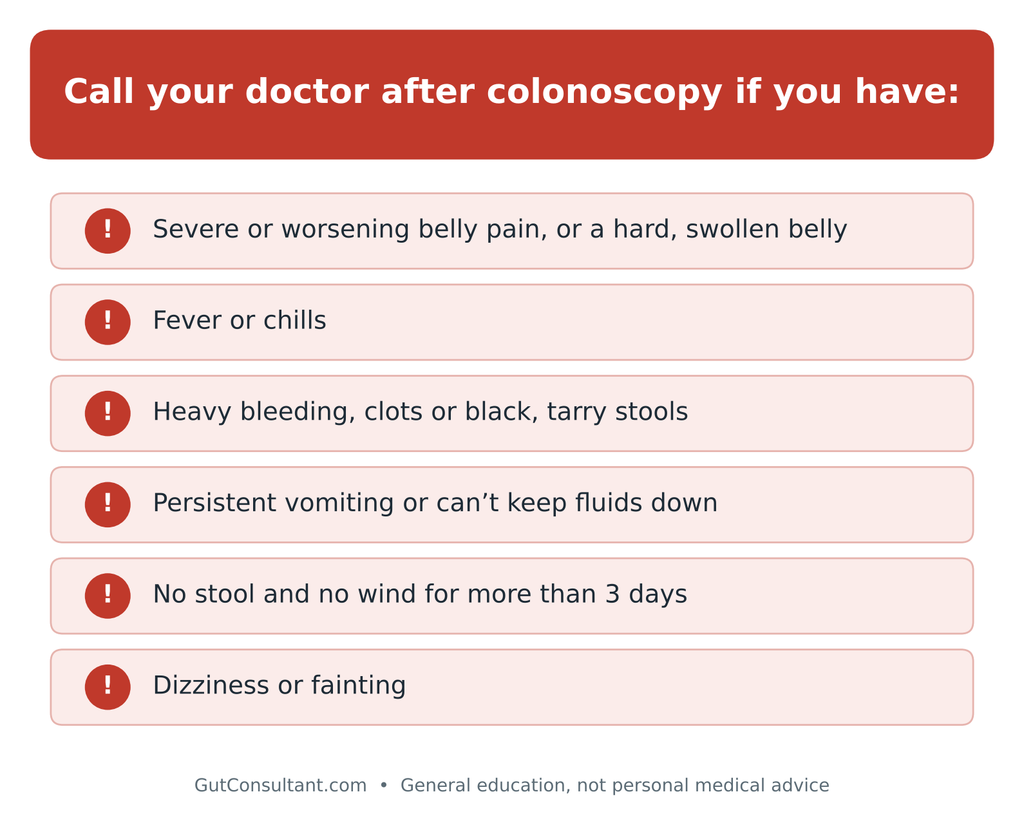
Contact your endoscopy unit or seek urgent care if you notice any of the following:
- Severe or worsening abdominal pain, or a swollen, hard belly
- Fever or chills
- Heavy bleeding, clots or black stools
- Persistent vomiting or inability to keep fluids down
- No bowel movement and no wind for more than three days, especially with pain or swelling
- Dizziness or fainting
These symptoms are uncommon. However, they can signal a complication such as bleeding or, rarely, a perforation (a small tear in the bowel wall). Early assessment makes a real difference.
Frequently Asked Questions
How long does it take for bowels to return to normal after colonoscopy?
Most people pass a stool within one to three days. Stools usually look normal again within three to five days. Mild irregularity for up to two weeks is common while gut bacteria recover.
Is it normal not to poop for 3 days after a colonoscopy?
It can be normal, because your colon was emptied completely. If you feel well and are passing wind, it’s usually not a concern. If you have pain, bloating or vomiting, call your doctor.
Why is my first bowel movement after colonoscopy watery or yellow?
Your colon still holds some prep fluid. Mixed with bile, it often looks yellow, green or watery. This usually clears within a day as solid food returns.
Can a colonoscopy cause long-term IBS?
There is no solid evidence that it does. Gut bacteria typically rebuild within about two weeks. More often, a bowel problem that existed before the test becomes noticeable again.
What should I eat for my first meal after colonoscopy?
Choose something light and easy to digest, such as soup, eggs, rice, toast or yoghurt. Avoid heavy, greasy or very spicy food for the first day.
The Bottom Line
Changes in bowel movements after colonoscopy are normal and usually short-lived. A slow first day, a few loose stools and some gas are all part of the gut resetting itself. Hydrate, eat gently, keep moving and give your bowel a few days. Know the red flags, and call your doctor if something feels wrong.
Medical disclaimer: This article is for general education and is not a substitute for personal medical advice. Always follow the discharge instructions from your own endoscopy team, and contact them with any concerns after your procedure.