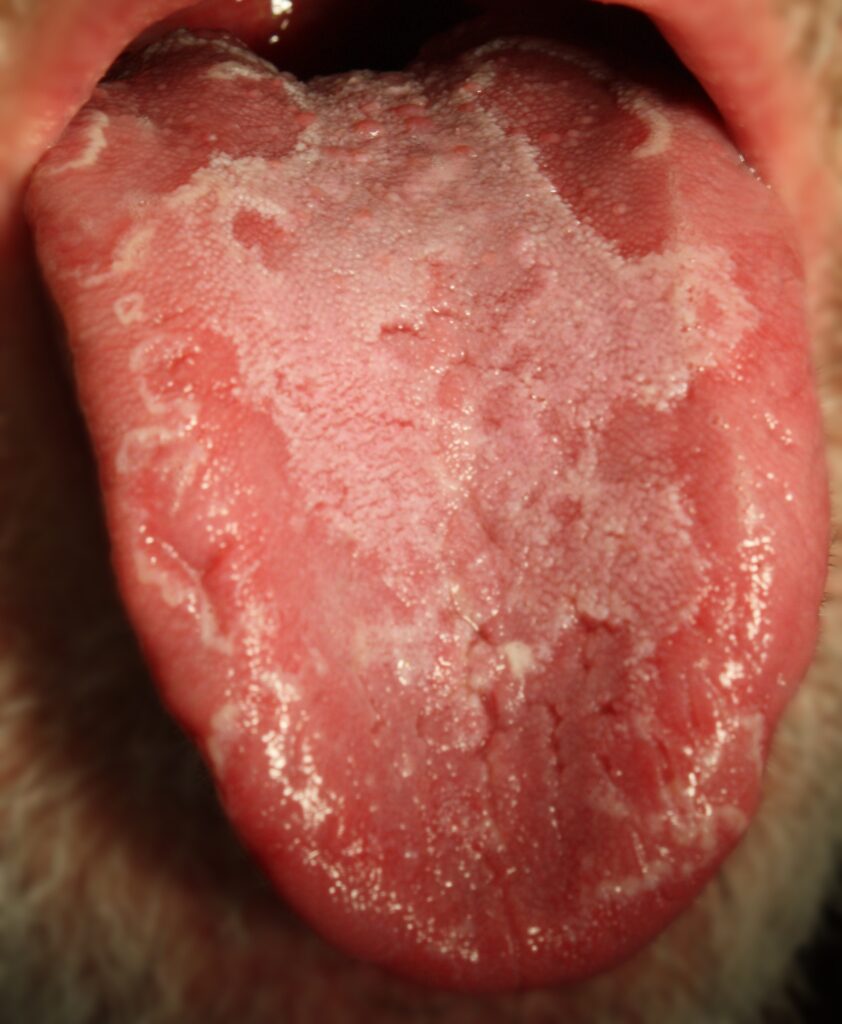
You expected a routine answer. Instead, your colonoscopy report contains a new phrase: terminal ileitis. Maybe the doctor mentioned redness or tiny ulcers at the end of your small bowel. Maybe the biopsy says “mild chronic active ileitis.” Now you are searching online, and every page seems to end with the same frightening word: Crohn’s.
Here is what many patients never hear. Terminal ileitis is a finding, not a diagnosis. In most people it does not turn out to be Crohn’s disease. This guide explains what the finding means, what else can cause it, and which tests and follow-up steps actually answer the question.
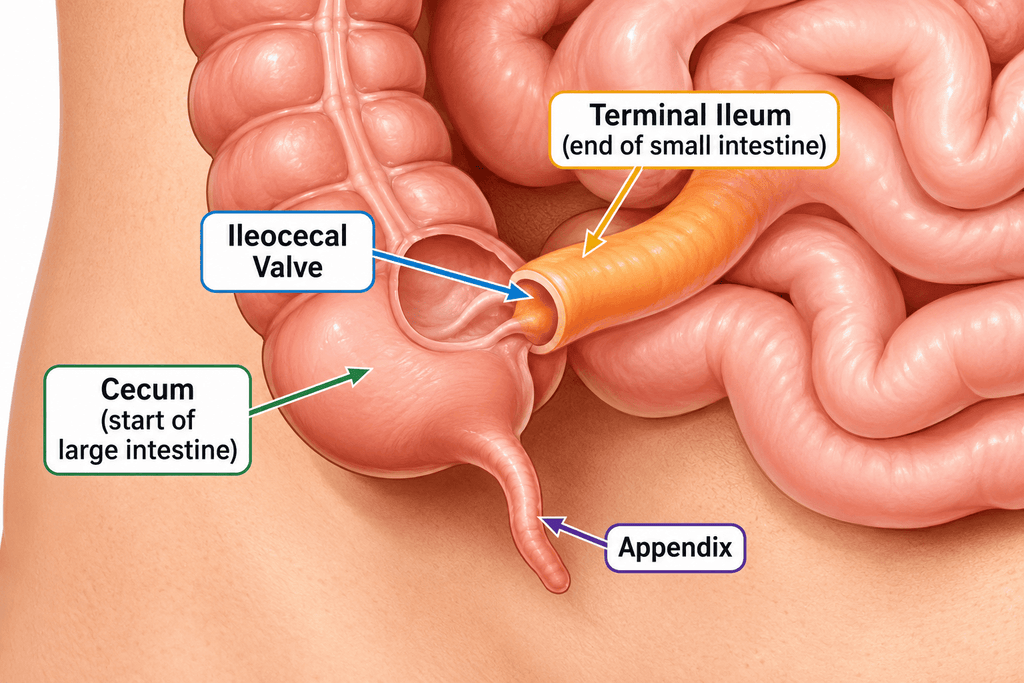
Image : Anatomical illustration
What Is Terminal Ileitis?
The ileum is the last section of the small intestine. Its final stretch, the terminal ileum, joins the large intestine through a small valve in the lower right abdomen. Doctors call that junction the ileocecal valve.
Ileitis means inflammation of the ileum. When the inflammation sits at the very end, we call it terminal ileitis. During colonoscopy, it can look like redness, swelling, small erosions, or ulcers. Under the microscope, a pathologist may see inflammatory cells in the lining.
The terminal ileum matters for two reasons. First, it absorbs vitamin B12 and bile acids, so long-lasting damage can affect nutrition. Second, it is the most common place for Crohn’s disease to start. That second fact explains why one line on a report can cause so much worry.
Why does trouble so often show up at this spot? The terminal ileum is rich in Peyer’s patches, the immune tissue that samples everything passing through the gut. Bacteria also become far more numerous as the small bowel approaches the colon. Infections, drug injury, and immune-driven disease all find an easy target here.
Terminal ileitis is not a single disease. It describes what the doctor saw. The real question is always the same: what caused it?
Terminal Ileitis Symptoms: What You May and May Not Feel
Symptoms depend on the cause and on how active the inflammation is. Some people feel nothing at all. When symptoms appear, they often include:
- Right lower abdominal pain or cramping, sometimes worse after meals
- Diarrhea, occasionally with mucus or blood
- Fever, especially when an infection is the trigger
- Weight loss and fatigue, when inflammation lasts for months
- Nausea or bloating, if the bowel narrows
Sudden (acute) terminal ileitis, often caused by infection, can mimic appendicitis. The pain starts quickly in the lower right abdomen. That is why some people reach the emergency room before anyone thinks about the ileum.
Chronic symptoms behave differently. They build over weeks or months. If that sounds familiar, our guides to the symptoms of Crohn’s disease and the five signs of active Crohn’s disease describe the patterns that deserve a gastroenterology visit.
Now the part most websites skip: many people with terminal ileitis have no symptoms. The doctor finds it by accident during a screening or polyp-surveillance colonoscopy. We call this incidental terminal ileitis. It behaves very differently from the symptomatic kind.
Terminal Ileitis Causes: Why Crohn’s Disease Is Only One Possibility
A 2017 study followed 74 people who had symptoms and isolated ulcers in the terminal ileum. After three to six months, doctors reached a firm diagnosis in about 60% of them. Crohn’s disease explained roughly one in four. NSAID injury, intestinal tuberculosis, and eosinophilic enteritis explained most of the rest. The remaining 40% had nonspecific ulcers, meaning no cause was ever found (Mehta et al., Endoscopy International Open).
Crohn’s Disease
Crohn’s is the cause everyone fears, and it is real. Several clues raise suspicion. Symptoms last for months. Blood tests show inflammation or anemia. The biopsy shows chronic changes, such as distorted glands or granulomas. (Granulomas are tight clusters of immune cells.) A 2026 study of 128 people with terminal ileitis on CT scans found that a lower blood albumin level was independently linked to a final Crohn’s diagnosis (Lu et al., JGH Open).
NSAIDs: Common Painkillers
Ibuprofen, diclofenac, and similar drugs are famous for causing stomach ulcers. Fewer people know they can injure the ileum too. In a series of 1,900 consecutive ileoscopies, doctors found ulcerative ileitis in 40 patients. Among those taking NSAIDs, the lesions disappeared when the drug was withdrawn and reappeared when it was resumed (Lengeling et al., Clinical Gastroenterology and Hepatology, 2003).
Patients often forget to mention over-the-counter painkillers. So tell your doctor about every one, including aspirin. Do not stop a prescribed medicine on your own, though. Let your doctor guide that decision.
Infections
Yersinia and Salmonella can inflame the terminal ileum, usually with fever and diarrhea. Less often, CMV, C. difficile, or amebiasis are responsible.
Intestinal tuberculosis deserves special attention. It favors the ileocecal region and can look almost identical to Crohn’s disease on colonoscopy. In regions where TB is common, doctors test for it before starting Crohn’s treatment. Reviews warn that treating missed TB with steroids or immunosuppressants can make the infection spread.
Other Causes
- Backwash ileitis. In ulcerative colitis, inflammation can spill back from the colon into the ileum. If you live with colitis, see our guide to the best foods for ulcerative colitis.
- Eosinophilic enteritis. An allergy-type inflammation rich in eosinophils, a kind of white blood cell.
- Lymphoid hyperplasia. The terminal ileum naturally holds a lot of immune tissue. When it enlarges, it can look inflamed. This reaction is benign.
- Reduced blood flow, radiation, tumors, or lymphoma. These are rare, but they are the reason biopsies matter.
- No cause found. This is common. Doctors call it idiopathic or nonspecific.
Incidental Terminal Ileitis: When the Colonoscopy Finds It by Chance
Colonoscopists now routinely enter the terminal ileum to confirm the exam was complete. As a result, they see more mild ileal changes in people with no symptoms.
How common is it? A 2021 meta-analysis pooled data from roughly 44,000 people who had screening or surveillance colonoscopies. Incidental terminal ileitis appeared in about 1.6%. Over one to seven years of follow-up, progression to overt Crohn’s disease was rare. The authors concluded that watchful waiting is likely reasonable, while noting that the data are limited (Agrawal et al., Journal of Crohn’s and Colitis).
Other studies point the same way:
- A Korean multicenter study followed 134 people with incidental ulcers in the terminal ileum. Most biopsies showed only chronic or active inflammation. At the second colonoscopy, 44% had no ulcers at all (Kim et al., Digestive Diseases and Sciences, 2021).
- A study of 108 patients with isolated acute terminal ileitis found that 4.6% went on to develop Crohn’s disease. That is 5 people, after a median of about 32 months (Tse et al., Digestive Diseases and Sciences, 2017).
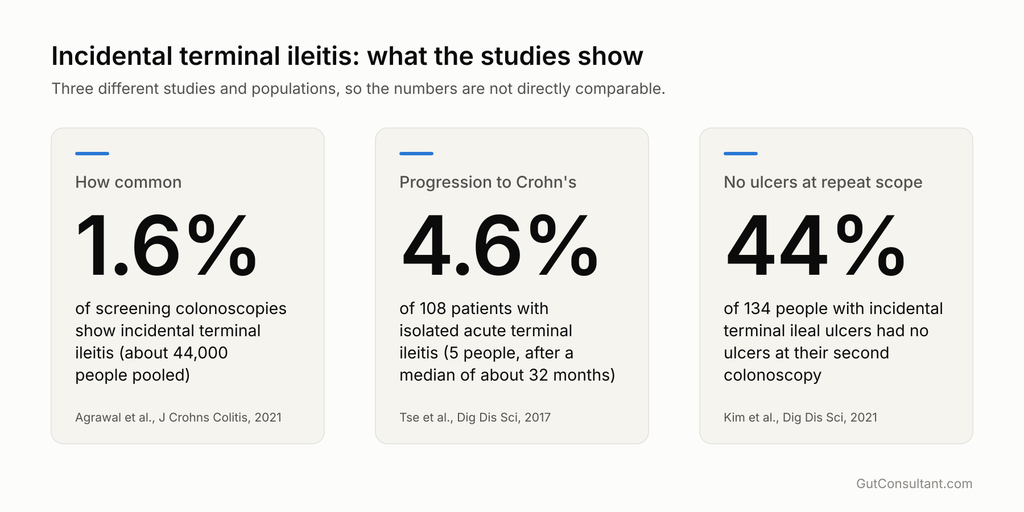
This reassurance applies to people with no symptoms, normal blood tests, and no history of inflammatory bowel disease. Symptoms or a raised CRP (a blood marker of inflammation) change the picture. In that case, your doctor will look harder.
Terminal Ileitis vs Crohn’s Disease: How Doctors Tell Them Apart
No single test separates the two. Doctors weigh the whole picture. This table shows the general pattern:
| Clue | Leans toward Crohn’s disease | Leans toward another cause |
|---|---|---|
| Symptom timeline | Months, slowly progressive | Days to weeks, or no symptoms |
| Medication history | Often no trigger | Regular NSAID use |
| Biopsy | Chronic changes, granulomas | Active inflammation only, lymphoid hyperplasia, eosinophils |
| Blood and stool | High CRP or calprotectin, low albumin, anemia | Normal markers, or a positive stool pathogen test |
| Imaging | Wall thickening, narrowing, other bowel segments involved | Isolated, mild changes |
| Course | Persists or worsens | Heals after stopping a drug or treating an infection |
Even these clues have limits. In the 2026 JGH Open study of 128 people with terminal ileitis on CT, only 12.5% ultimately had Crohn’s disease. Infectious and surgical causes were the most common non-Crohn’s explanations. Routine inflammatory markers helped little on their own. That is why doctors rarely decide on a single result.
How Terminal Ileitis Is Diagnosed: What Happens After the Colonoscopy
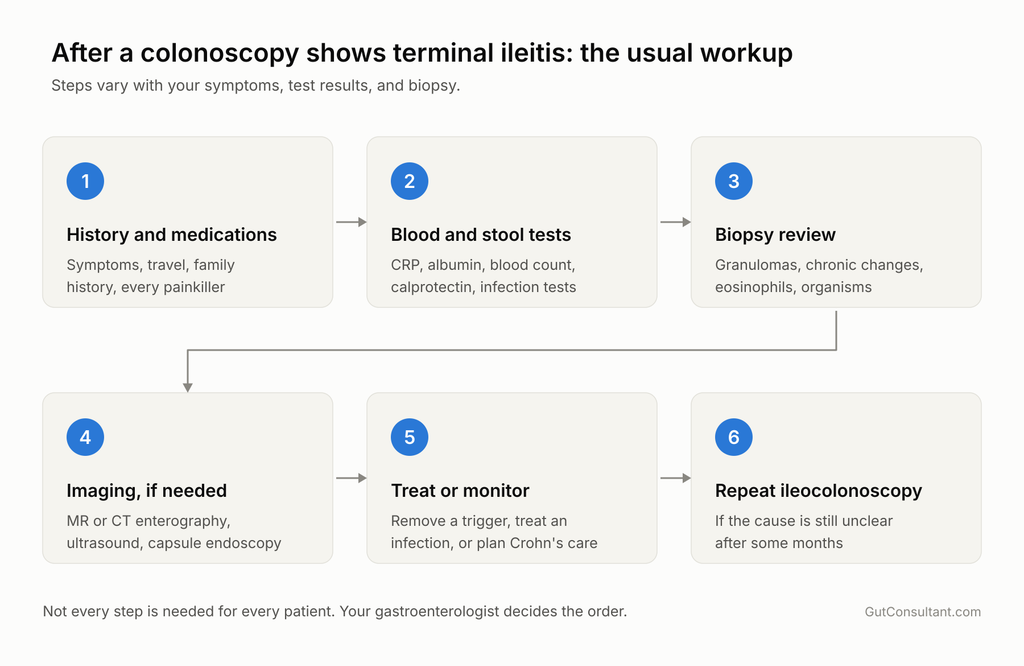
Your gastroenterologist will usually combine several steps:
- A careful history. Symptoms, duration, travel, family history, and every medication, including over-the-counter painkillers.
- Blood tests. CRP, blood count, albumin, iron, and vitamin levels.
- Stool tests. Fecal calprotectin and tests for infection.
- Biopsy review. The pathologist looks for granulomas, chronic changes, eosinophils, or organisms.
- Imaging. MR enterography, CT enterography, ultrasound, or capsule endoscopy can examine the small bowel beyond the colonoscope’s reach.
- Tuberculosis testing, where it is relevant.
- A repeat ileocolonoscopy after some months if the cause is unclear, or after a suspected trigger is removed.
How to Read Your Terminal Ileitis Biopsy Report
Biopsy wording can sound alarming. Here is what common phrases usually mean:
- “Active ileitis.” White blood cells called neutrophils are present, so inflammation is current. It does not name the cause.
- “Chronic ileitis” or “chronic active ileitis.” The inflammation has lasted a while. Together with distorted gland structure, it raises the possibility of Crohn’s disease.
- “Lymphoid hyperplasia” or “prominent lymphoid aggregates.” Normal terminal ileum tissue contains plenty of immune cells. This finding is often benign.
- “No granulomas seen.” Reassuring, but it does not exclude Crohn’s, because only a minority of Crohn’s biopsies contain granulomas.
- “Nonspecific.” The pathologist found inflammation but no clear cause. Your doctor will combine it with your symptoms and test results.
Ask your doctor to explain your exact report. Wording varies between pathologists.
Terminal Ileitis Treatment: It Depends on the Cause
There is no single treatment, because terminal ileitis is not a single disease. Doctors treat the cause:
- Drug-related ileitis. Stopping the offending medication, under medical supervision, often lets the ileum heal.
- Infection. Some mild infections settle on their own. Others need targeted antibiotics.
- Intestinal tuberculosis. A full course of anti-tuberculosis treatment. Improvement on treatment also helps confirm the diagnosis.
- Eosinophilic enteritis. Diet changes, steroids, or both, guided by a specialist.
- Crohn’s disease. Anti-inflammatory or immune-modulating therapy chosen by a gastroenterologist, plus nutritional support. Our Crohn’s disease diet guide covers the food side.
- Nonspecific or incidental findings. Often no drug treatment at all. Doctors monitor symptoms and blood tests, and they repeat the scope if something changes.
The outlook is encouraging. In the 2017 series, symptoms resolved after treatment in about 92% of patients. Repeat endoscopy showed healing in about 78% of those who had it.
Doctors also avoid starting Crohn’s therapy until infection, especially tuberculosis, is reasonably excluded. A steroid course given for unrecognized TB can do real harm.
Living With a Terminal Ileitis Finding: Practical Next Steps
- Ask five questions. Were biopsies taken, and what did they show? Which blood and stool tests do I need? Could any medicine I take be involved? Do I need imaging? When should the scope be repeated?
- Keep a short symptom diary. Note pain location, stool pattern, fever, and weight.
- Share everything you take. Include painkillers, supplements, and herbal products.
- Keep your follow-up appointments, even when you feel well.
- Look beyond the bowel if tests stay normal. Pain in the lower abdomen does not always come from the ileum. Our article on chronic abdominal wall pain explains a common and often overlooked cause.
When to See a Doctor About Terminal Ileitis
Contact your doctor promptly if you have:
- Pain in the lower right abdomen that lasts more than a few days
- Fever with abdominal pain
- Blood in your stool
- Unintentional weight loss
- Diarrhea lasting several weeks
- Repeated vomiting, or bloating with no passage of gas or stool
Severe, sudden pain, or an inability to pass gas or stool, needs urgent medical care.
Frequently Asked Questions About Terminal Ileitis
Is terminal ileitis serious?
It depends on the cause. Mild, incidental findings in people with no symptoms are usually not serious. Ulcers with symptoms, weight loss, or abnormal blood tests need a full workup.
Does terminal ileitis always mean Crohn’s disease?
No. About one in four symptomatic patients in one 2017 series had Crohn’s disease. Among people with incidental findings, progression to Crohn’s is rare.
Can terminal ileitis go away on its own?
Yes. In the Korean study, 44% of people had no ulcers at their second colonoscopy. NSAID-related damage can heal after the drug stops.
Do I need another colonoscopy?
Sometimes. Your symptoms, blood tests, and biopsy result decide. Ask your gastroenterologist about timing.
Can diet cure terminal ileitis?
No diet cures it. Diet supports nutrition and comfort, and it becomes part of treatment if Crohn’s disease is confirmed.
This article is for general education and does not replace an in-person medical evaluation. If your colonoscopy report mentions terminal ileitis, discuss the findings and the next steps with your gastroenterologist.