You’ve had the colonoscopy. The endoscopy. The abdominal ultrasound, maybe a CT scan, and a full panel of blood work. Every report comes back the same way: normal. And yet the pain in your belly hasn’t moved. It’s often in the exact same spot, week after week.
If that sounds familiar, you may be dealing with chronic abdominal wall pain. It’s a real and surprisingly common source of persistent belly pain. And it has nothing to do with your intestines, stomach, or liver. Instead, it comes from the wall of the abdomen itself — the muscle, fascia, and small nerves sitting just under the skin.
It’s one of the most overlooked diagnoses in gastroenterology. Standard GI tests are built to look inside the abdomen, not at the wall surrounding it. This guide covers what chronic abdominal wall pain actually is. It explains why it’s missed so often, how it’s diagnosed with one simple bedside test, and what treatment looks like.
What Is Chronic Abdominal Wall Pain?
Chronic abdominal wall pain, often shortened to CAWP, comes from the structures of the abdominal wall. That means the skin, muscle, fascia, and small sensory nerves running through them — not an internal organ.
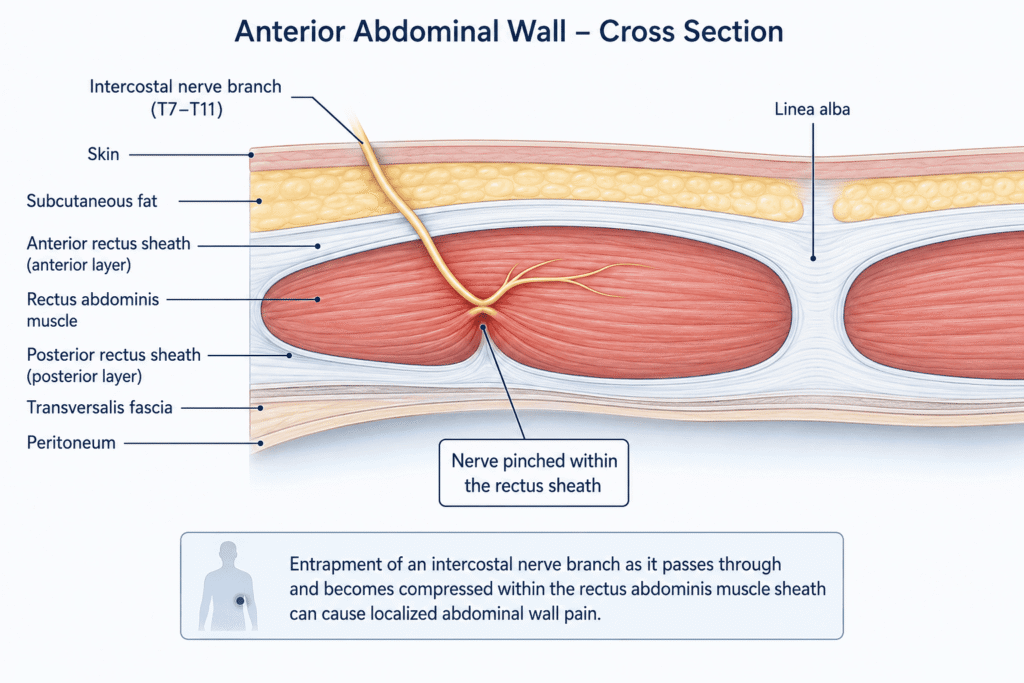
That distinction matters more than it sounds. Doctors separate pain into two broad types. Visceral pain comes from an organ, such as the stomach, gallbladder, or colon. Somatic pain comes from the skin, muscle, or connective tissue covering the body. Visceral pain tends to be diffuse. It’s hard to pinpoint with one finger, and it’s closely tied to eating, digestion, or bowel habits. Chronic abdominal wall pain behaves differently. It’s usually fixed to one small spot, often no larger than a fingertip. And it doesn’t rise and fall with meals or bowel movements the way digestive pain typically does.
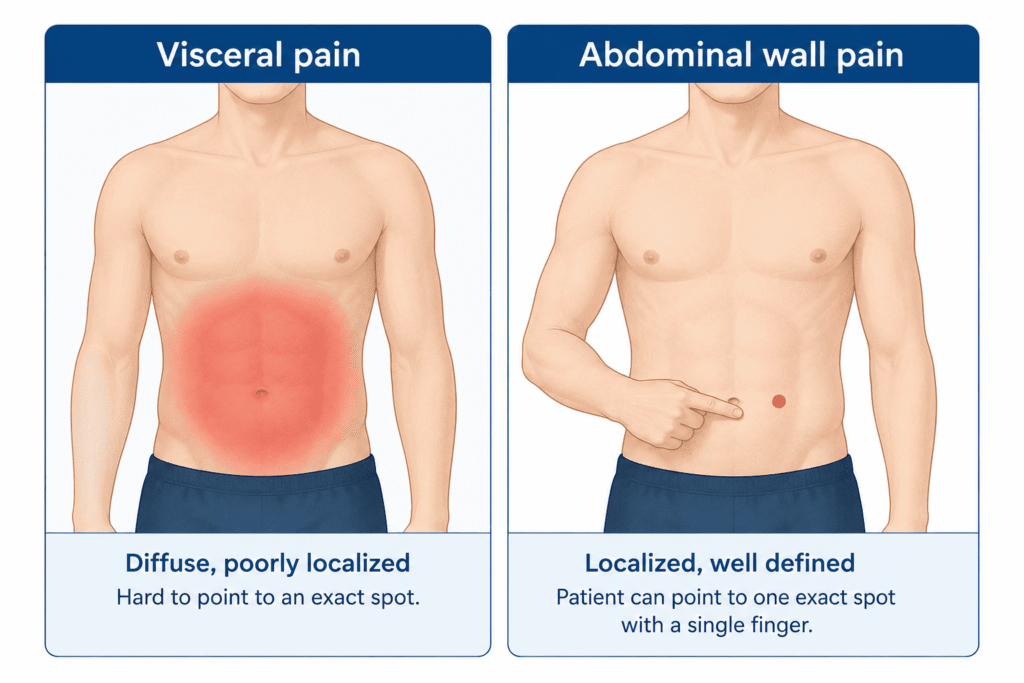
The most common underlying cause has a specific name: anterior cutaneous nerve entrapment syndrome (ACNES). This happens when small nerve branches get pinched as they pass through the abdominal wall muscle on their way to the skin. Less often, a similar pain pattern comes from a small hernia in the muscle wall, a tender surgical scar, or a trigger point in the muscle itself.
Why Chronic Abdominal Wall Pain Gets Mistaken for a Digestive Problem
This is the part patients usually find most frustrating. It’s worth explaining clearly.
Research on patients with unexplained chronic abdominal pain has found something striking. Somewhere between 10% and 30% of them are eventually diagnosed with chronic abdominal wall pain. Usually, this happens only after a full workup has already come back clean. Despite that, doctors making the initial referral suspect it in only around 3% of the patients who actually turn out to have it. That gap exists for a good reason. Most abdominal pain genuinely is coming from the gut. So it makes sense to evaluate for the far more common explanations first: irritable bowel syndrome, gastritis, gallbladder disease, or the kind of trapped gas and bloating our guide to burping and gas walks through in more detail.
The overlap with IBS specifically is well documented. One study screened patients who already carried a diagnosis of functional abdominal pain, including IBS. Researchers used a validated questionnaire designed to flag abdominal wall involvement. Among the patients who screened positive and went on to a full evaluation, roughly half turned out to have an abdominal wall pain syndrome instead. ACNES specifically was confirmed in about 1 in 28 of all symptomatic patients screened. That doesn’t mean IBS is commonly misdiagnosed — it remains by far the more frequent cause of chronic belly pain. But it does mean a wall-based cause is worth ruling out, especially when the pain stays fixed to one small point and the usual gut-related explanations don’t quite fit.
Part of the confusion is that up to half of people with chronic abdominal wall pain also describe mild bloating, nausea, or a change in bowel habits. These symptoms often show up alongside the localized pain. They’re thought to be reflexive, rather than a sign of a separate digestive problem. But they’re understandably enough to steer an initial workup toward the gut — the same way causes of bloating we’ve covered before can send someone looking for a dietary or motility explanation first.
What Causes Chronic Abdominal Wall Pain?
The Nerve Entrapment Behind Most Cases
The abdominal wall is crossed by small nerve branches. These come off the lower thoracic intercostal nerves, roughly the ones labeled T7 through T12. To reach the skin, the branches have to pass through a narrow tunnel. That tunnel runs through the rectus abdominis — the vertical “six-pack” muscle — and the fascia surrounding it.
That narrow passage is where the trouble starts. Repeated muscle tension, scarring, or simply an unlucky anatomical angle can pinch the nerve as it exits. It’s much the same way the median nerve gets pinched in carpal tunnel syndrome. Once entrapped, the nerve fires pain signals from that one fixed point. The pain is often burning or stabbing. And it happens largely independent of what’s actually going on inside the abdomen.
Other Contributing Causes
A few other sources can produce a similar pattern of fixed, wall-based pain:
- Surgical scars. Nerve fibers can get caught in scar tissue after an appendectomy, C-section, hernia repair, or laparoscopic surgery. Sometimes the pain doesn’t start until months or years later.
- Small abdominal wall hernias. A tiny gap in the muscle can trap fat or tissue. It’s occasionally too small to see clearly on standard imaging.
- Myofascial trigger points. These are tight knots within the abdominal muscles, often related to posture or repetitive strain. They’re less well studied than ACNES specifically.
- Pregnancy and rapid weight change. Both stretch and reshape the abdominal wall. That can put new tension on the nerve branches running through it.
Most people who develop chronic abdominal wall pain have no clear trigger at all. It simply develops gradually. That’s part of what makes it so easy to overlook.
Recognizing the Symptoms of Chronic Abdominal Wall Pain
Where the Pain Shows Up
The single most useful clue is how precisely someone can point to their pain. People with chronic abdominal wall pain can almost always put one finger directly on the spot. It’s often less than an inch across. That’s unusual for pain coming from inside the abdomen. Internal pain tends to feel broader and harder to locate.
The pain can occur anywhere along the abdominal wall. But one spot is especially common: just to the side of the belly button, along the outer edge of the rectus muscle, on either side.
What Makes It Worse — and What Doesn’t
A few patterns tend to point toward the wall rather than an organ underneath it:
- Pain that gets worse, not better, with movements that tighten the stomach muscles — sitting up, coughing, laughing, or a sit-up
- Pain that stays roughly the same regardless of eating, fasting, or bowel movements
- A burning, stabbing, or electric quality rather than a cramping or aching one
- Tenderness confined to one small, consistent point over weeks or months
- Occasional numbness or unusual sensitivity of the skin directly over the spot
A few signs are genuinely reassuring: no fever, no unintentional weight loss, no blood in the stool, no persistent vomiting, and no pain that keeps steadily worsening. If any of those are present, they point back toward an internal cause. That combination deserves prompt medical evaluation, not reassurance about the abdominal wall.
How Chronic Abdominal Wall Pain Is Diagnosed: The Carnett’s Test
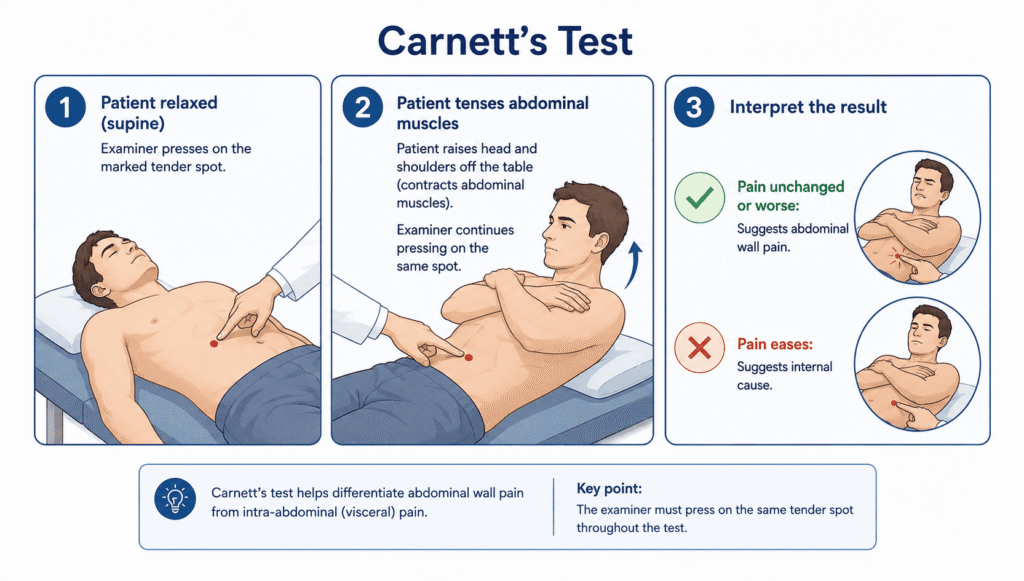
The reassuring part is that chronic abdominal wall pain doesn’t require another round of imaging to diagnose. It requires a specific bedside exam that takes under a minute. It’s called the Carnett’s test (or Carnett’s sign), first described by surgeon John Carnett in 1926. It’s still the standard today.
How it works: Lying flat and relaxed, the examiner presses on the exact tender spot and notes how much it hurts. The patient then tenses their abdominal muscles. Usually this means lifting the head and shoulders slightly off the table, or raising both legs. The examiner keeps pressing on that same spot the whole time.
- If the pain eases once the muscles are tensed, the contracted muscle is shielding an organ underneath it. That’s a negative test, pointing toward a visceral, internal cause.
- If the pain stays the same or worsens with tensed muscles, the source is in the wall itself. That’s a positive test, consistent with chronic abdominal wall pain.
This one maneuver has good diagnostic accuracy when performed by an examiner familiar with it. That’s exactly why it’s worth specifically asking your doctor to perform it, especially if your GI workup has already come back clean and your pain stays confined to one spot.
Sometimes the exam is positive but the picture is still unclear. In that case, many doctors follow up with a diagnostic nerve block — a small injection of local anesthetic directly into the tender point. A drop in pain of 50% or more shortly afterward strongly supports the diagnosis. It often provides real, if temporary, relief along the way too.
Treating Chronic Abdominal Wall Pain
Treatment generally follows a stepwise approach. It starts with the least invasive options and moves on only if they aren’t enough.
Starting Point: Conservative Measures
For milder cases, simple measures are often sufficient:
- Avoiding the specific movements or postures that reliably trigger the pain
- Warm compresses or topical anesthetic patches placed directly over the tender point
- Physical therapy focused on the abdominal wall and core, when a muscular component is suspected
- In some cases, medications typically used for nerve-related pain, matched to the individual by a physician — this is a decision to make together, not something to start on your own
Trigger Point or Nerve Block Injections
Sometimes conservative measures fall short. When that happens, the usual next step is an injection of local anesthetic, often combined with a steroid, directly into the tender point. For many patients, it works well. Some people need only one injection. Others benefit from a short series spaced a few weeks apart.
When to Consider a Specialist Referral
Sometimes injections only bring short-lived relief, or the pain keeps returning. In that case, it’s entirely reasonable to ask for a referral to a pain specialist or a surgeon experienced with abdominal wall nerve conditions. Further options exist at that stage. These range from targeted nerve-modulating procedures to a minor procedure that releases the entrapped nerve. Both are genuinely effective for many long-standing cases, and both are worth discussing rather than simply living with the pain indefinitely.
Here’s the most important message: a normal colonoscopy, endoscopy, ultrasound, and CT scan do not mean your pain isn’t real. They don’t mean nothing more can be done, either. They mean the source likely isn’t visceral. And that’s genuinely useful information — it points your care in the right direction.
When to See a Doctor
Ask your doctor to specifically examine for chronic abdominal wall pain if:
- Your pain is confined to one small, consistent spot you can point to with a single finger
- A GI evaluation, including bloodwork, imaging, and possibly endoscopy, has come back normal
- The pain doesn’t track with eating, fasting, or bowel movements
- Tensing your abdominal muscles makes the pain the same or worse, rather than better
Some symptoms need faster attention. Seek prompt medical care, rather than waiting for a routine follow-up, if the pain comes with fever, vomiting, blood in the stool, unintentional weight loss, or a severity that keeps climbing. Those features point toward causes that need more urgent evaluation.
Frequently Asked Questions
Is chronic abdominal wall pain dangerous?
No. It isn’t linked to any serious underlying disease, and it doesn’t progress into anything more dangerous. It can, however, be genuinely disabling day to day. That’s exactly why getting the diagnosis right matters.
Can I check for this myself at home?
You can get a rough sense using the same principle as the Carnett’s test. Press on the tender spot while lying down relaxed, then press again while tensing your abdominal muscles. This isn’t a substitute for a proper in-person exam. It shouldn’t be used to rule anything urgent out on your own. But it’s a useful way to describe your pain accurately at your next appointment.
Why hasn’t my doctor mentioned this before?
Awareness of chronic abdominal wall pain varies quite a bit between practitioners. The standard workup for abdominal pain understandably focuses on the organs first. If your tests are normal and the pain persists, it’s entirely reasonable to bring up chronic abdominal wall pain and the Carnett’s test by name at your next visit.
Does this ever go away without treatment?
Sometimes, especially when it follows a specific trigger such as pregnancy or a recent surgery. But it often persists for months or years without a clear diagnosis. That’s exactly why identifying it matters, even in milder cases.
This article is intended for general education. It isn’t a substitute for an in-person medical evaluation. If you have persistent, unexplained abdominal pain, please see a physician — ideally one willing to specifically examine for an abdominal wall source once the more common causes have been considered.