If you’ve ever unbuttoned your jeans by 8 p.m. despite eating “normally” all day, you already know the pattern: flat stomach in the morning, tight and swollen by dinner. Understanding why does bloating get worse in the evening starts with one key fact — evening bloating is almost never caused by a single meal. It’s the accumulated result of everything your gut has processed, and how it has processed it, since you woke up.
This isn’t just an inconvenient coincidence. Your digestive tract runs on its own daily rhythm, and by evening several of those rhythms are working against you at once. By the evening motility slows, gas has had all day to accumulate, posture and inactivity trap it in place, and the day’s stress hormones are still circulating. The good news is that once you understand the mechanism, evening bloating is one of the more manageable gut complaints to reduce.

Why Does Bloating Get Worse in the Evening? The Short Answer
In most people without an underlying disorder, evening bloating happens because:
- Gut motility naturally slows as the day goes on, especially overnight.
- Gas builds cumulatively from every meal, snack, and drink you’ve had.
- Reduced movement and prolonged sitting make it harder for trapped gas to travel and exit.
- Cortisol and stress accumulated through the day can slow digestion further.
- Dinner is often the largest, richest, and most rushed meal, adding a final load to an already tired system.
None of these factors work in isolation — they stack. That’s why the same lunch that barely registers at noon can feel like a brick by 9 p.m.
Why Does Bloating Get Worse in the Evening: Your Gut’s Daily Clock
Your digestive system isn’t equally active around the clock. Between meals, the small intestine runs a “housekeeping” pattern called the migrating motor complex (MMC). This is a series of sweeping muscular contractions that clear out leftover food particles, bacteria, and debris. Researchers have measured this directly: a study using pressure-sensitive capsules found a significant difference between daytime and nocturnal propagation speeds of the migrating motor complex. They found the contractions moving roughly twice as fast during the day as at night. The same slowdown pattern showed up in people with irritable bowel syndrome.
In plain terms: your gut’s internal “cleanup crew” works faster in daylight hours and downshifts as the evening goes on. Content that would have been swept through efficiently at 10 a.m. moves more sluggishly at 8 p.m. This givies gas-producing bacteria more time to ferment whatever’s left in the pipeline.
This is also part of why does bloating get worse in the evening? It has such a consistent answer across so many people — it isn’t random, it’s built into normal gastrointestinal physiology. The MMC is sometimes called the gut’s “self-cleaning cycle,”. Its natural evening slowdown is one of the most well-documented reasons digestion feels heavier at night than in the morning.
The Cumulative Gas Effect
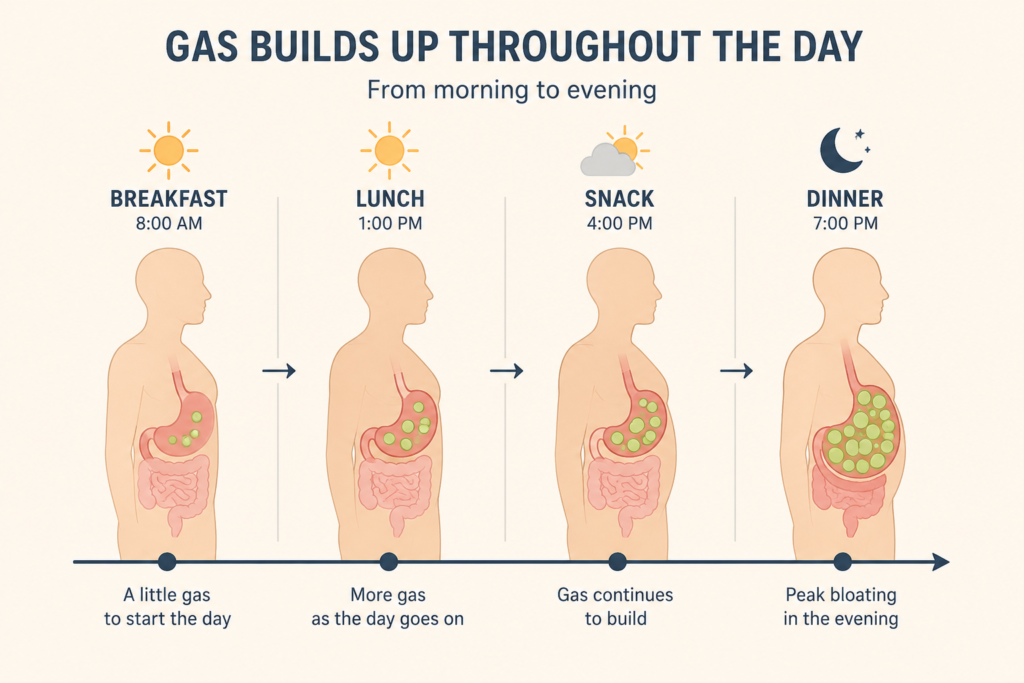
Every meal — even a “clean,” well-tolerated one — produces some gas. Gut bacteria ferment leftover carbohydrates and fiber in the colon. On its own, a small amount of gas from breakfast is unnoticeable. But add lunch, an afternoon snack, coffee, and dinner on top of it, and the gas load compounds hour by hour.
If your gut is efficiently clearing gas throughout the day — through movement, upright posture, and normal motility — this usually isn’t a problem. But if elimination is even slightly slower than production, gas accumulates faster than it’s expelled. By nightfall, you’re carrying the fermentation residue of the entire day, not just dinner.
People report feeling fine in the morning. Overnight, while you sleep, the MMC still runs its cycles (just more slowly). By the time you wake, a lot of that gas has finally worked its way through.
Why Does Bloating Get Worse in the Evening: The Posture and Movement Factor
Digestion is more mechanically efficient when you’re upright and moving. Standing and walking use gravity and gentle core engagement to help gas and food content move through the GI tract. Sitting at a desk for eight hours, then sitting again for dinner, then sitting or lying down afterward removes nearly all of that mechanical assistance.
Lying down soon after eating compounds the problem further. When you’re horizontal, gas and stomach contents have less “downhill” pressure helping them move. Swallowed air can sit higher in the stomach rather than passing through. If your evening routine is dinner followed shortly by the couch, you’re stacking a low-motility time of day on top of a low-motility posture.
As covered in our guide to manage burping and gas, simple habits like staying upright after meals and avoiding gulped food or drinks can be helpful. It reduces how much trapped air and gas builds up by nightfall.
Stress, Cortisol, and Why Evenings Hit Differently
Stress doesn’t just affect your mood — it directly changes how your gut moves. The gut and brain communicate constantly through what’s known as the gut-brain axis. Stress hormones are a major part of that conversation. When cortisol rises in response to stress, it acts on the gut to alter GI tract function, autonomic tone, and visceral perception. This means stress can both slow digestion and make normal sensations of fullness or gas feel more uncomfortable than normal.
If your day involved back-to-back meetings, a stressful commute, or general low-grade tension, your nervous system may still be in a heightened state by dinnertime. This is true even if you don’t consciously feel “stressed” anymore. That lingering activation can slow gastric emptying. It also slows intestinal movement right when you’re adding a full dinner to the mix. This combination finally shows up as evening bloating.
This connection also explains why the same dinner can feel completely fine on a relaxed weekend and uncomfortable after a demanding workday. The food isn’t the variable — your nervous system state is.
Dinner Itself: Timing, Size, and Composition
By the time dinner rolls around, three things often converge to make it the most bloating-prone meal of the day:
- It’s frequently the largest meal. Many people underfed during the day compensate at dinner, asking a slowing digestive system to process a disproportionate share of daily calories.
- It’s eaten closer to inactivity or sleep. There’s less time and movement afterward to help things along.
- You may often eat quickly, especially on weeknights, which increases air-swallowing (aerophagia) — a distinct but common contributor covered in our guide to water bloating.
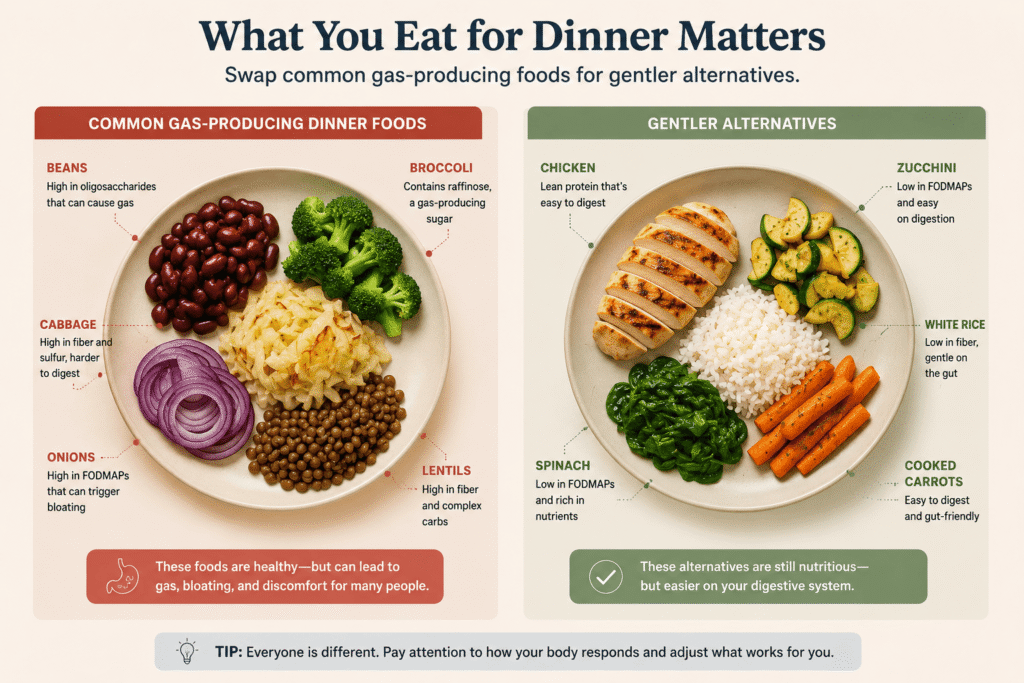
Certain dinner staples are also more fermentable than others. Cruciferous vegetables, beans and legumes, garlic, onions, and high-FODMAP ingredients generate more gas as they’re broken down by colon bacteria — not a problem in isolation, but a meaningful addition on top of a full day’s fermentation load. If garlic is a regular part of your evening cooking and you notice a pattern, our article on garlic and constipation covers how FODMAP-sensitive individuals can adjust intake without cutting it out entirely.
When Evening Bloating Might Signal Something More
Mild, predictable evening bloating that resolves overnight is common and usually not a sign of underlying disease. But it’s worth paying closer attention if you notice:
- Bloating that’s severe, painful, or steadily worsening over weeks
- Bloating paired with unintended weight loss, vomiting, or blood in the stool
- A significant, lasting change in bowel habits alongside the bloating
- Bloating that no longer improves with basic lifestyle adjustments
- A family history of digestive disorders alongside progressive symptoms
Persistent or worsening evening bloating can also point toward small intestinal bacterial overgrowth (SIBO), a condition linked to disrupted migrating motor complex function, or an underlying motility disorder. These are diagnosable conditions, not something to self-treat — if the pattern above sounds familiar, it’s worth bringing up with a gastroenterologist rather than guessing.
How to Reduce Evening Bloating: Practical Adjustments
None of these require a total overhaul — small, consistent changes throughout the day tend to outperform trying to “fix” bloating at dinner alone.
Spread your eating out. Instead of loading most of your calories into dinner, aim for more balanced meals across the day. This keeps the digestive demand steadier and avoids handing your slowing evening gut its biggest job of the day.
Stay upright after eating. Give your body 1–2 hours in an upright position after dinner before lying down. A short walk is even better than sitting.
Move during the day, not just after dinner. Regular movement throughout the day supports baseline motility, so your gut isn’t starting the evening already behind.
Watch pace, not just content. Eating quickly and talking a lot while eating both increase swallowed air. Slowing down at dinner specifically (even if you eat normally at lunch) can meaningfully reduce evening gas.
Manage the day’s stress before dinner, not during it. A few minutes of decompression — a walk, deep breathing, stepping away from screens — before your evening meal can lower the physiological stress load your gut is digesting alongside your food.
Be strategic with known trigger foods at dinner specifically. You don’t need to eliminate beans, garlic, or cruciferous vegetables — but if evening bloating is a consistent problem, shifting your highest-FODMAP dishes to lunch, when your gut is more efficient, can reduce the nightly buildup.
FAQ: Why Does Bloating Get Worse in the Evening?
Why am I bloated every night but flat every morning?
This pattern reflects normal daily accumulation of gas and slowing gut motility, followed by overnight clearance via the migrating motor complex while you sleep and fast. It’s one of the most common and usually benign bloating patterns.
Does lying down after eating make bloating worse?
Yes, generally. Digestion is more efficient upright, and lying down can make trapped gas feel more pronounced by removing the gravitational assistance that helps it move through and out.
Is evening bloating a sign of IBS?
Not necessarily — evening bloating happens in people without IBS too, since it’s tied to normal daily gut rhythms. However, people with IBS often report the same evening pattern more intensely, since their motility and gas sensitivity tend to be more reactive.
Can drinking water in the evening cause bloating?
It can contribute if you’re drinking quickly, drinking carbonated water, or drinking large amounts alongside a meal, since this can slow gastric emptying and increase swallowed air. See our full breakdown in water bloating for specifics.
When should I see a doctor about evening bloating?
If bloating is severe, painful, progressively worsening, or accompanied by weight loss, blood in the stool, or a major change in bowel habits, it’s time for a medical evaluation rather than continued self-management.
The Bottom Line
Why does bloating get worse in the evening? Because your gut’s natural motility slows down, gas accumulates cumulatively across the day, movement and posture work against you, and stress hormones add one more layer on top of a full dinner. None of these factors are dramatic on their own — but by nightfall, they stack. Spreading meals more evenly, staying upright and active, managing stress before dinner, and being thoughtful about your evening menu can meaningfully reduce the pattern for most people.
This article is intended for general educational purposes and is not a substitute for personalized medical advice. If evening bloating is severe, persistent, or accompanied by other concerning symptoms, please consult a gastroenterologist or your healthcare provider.